A new study by Women in Cycling Germany, in collaboration with IFH KÖLN, has shown that women represent one of the largest untapped growth opportunities in the industry.
After the pandemic boom years, revenues are declining, price promotions are squeezing margins, and increased competition is putting pressure on manufacturers and retailers alike. The IFH KÖLN forecast is unambiguous: no significant growth is expected in the German bicycle market by 2030. This makes the question of where new demand and additional revenue potential can be found all the more urgent.
Through targeted activation of female target groups, additional revenues of between 520 and 950 million euros could be unlocked in the bicycle market – including accessories, apparel, and services – by 2030. The study has detailed that in the bicycle segment alone, the additional potential reaches up to 570 million euros.
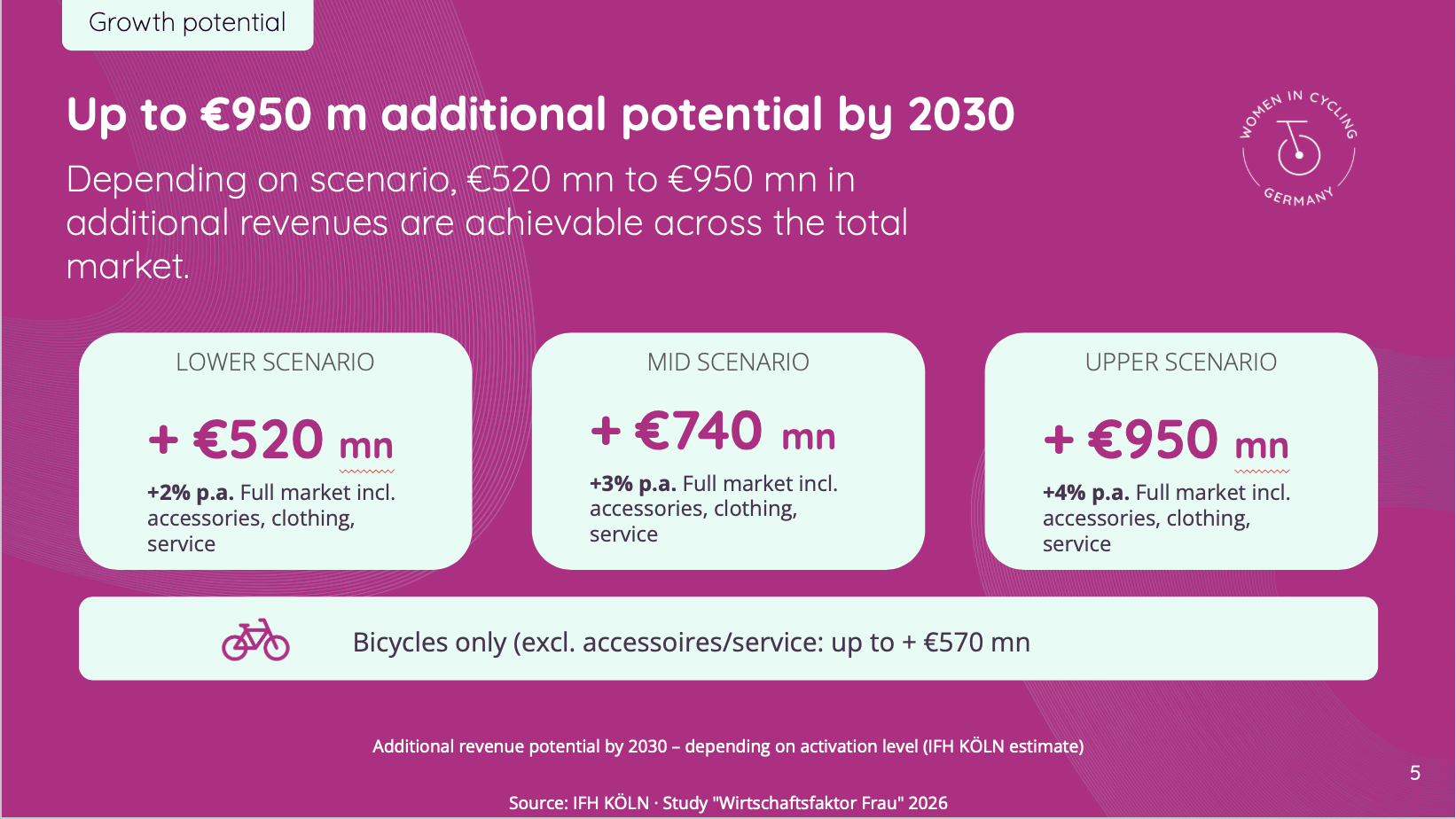
According to IFH KÖLN, the forecast anticipates broad stagnation in the overall market through 2030; stronger engagement of female target groups could generate additional market growth of two to four per cent in this segment.
A Billion-Euro Potential Remains Untapped
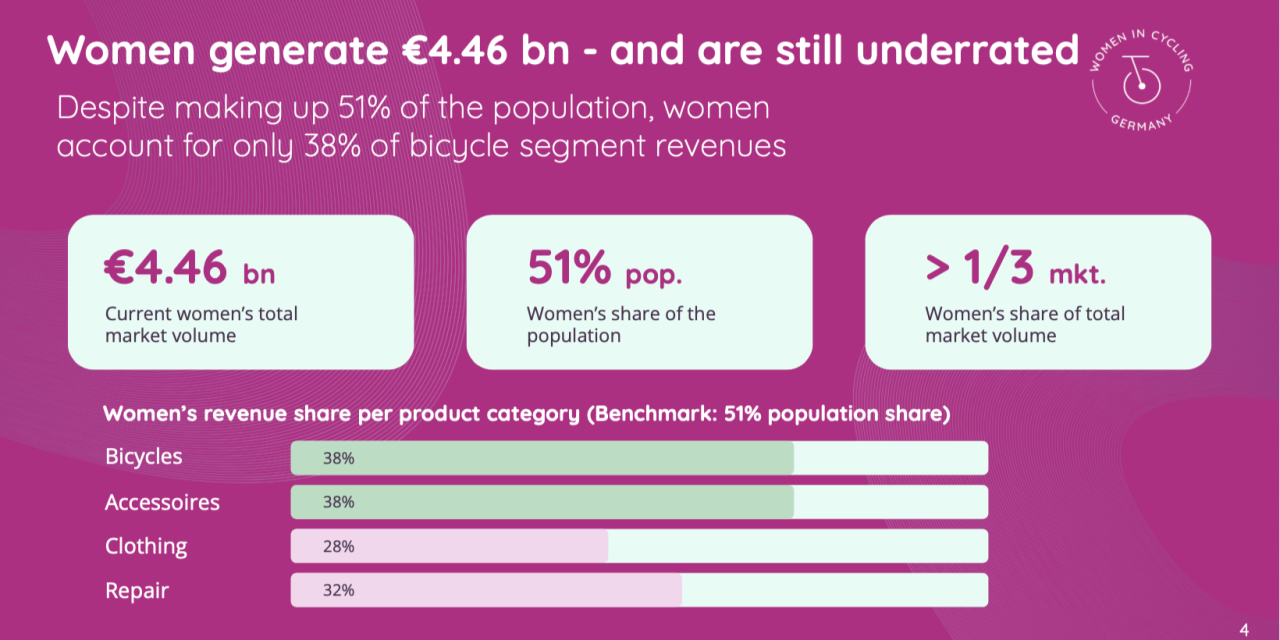
The study shows that although women account for around 51 per cent of the population, they currently generate only 38 per cent of revenue in the bicycle segment. In apparel, the figure drops to just 28 per cent; in repair services, to 32 per cent. At the same time, women already generate a market volume of approximately 4.46 billion euros across bicycles, accessories, apparel, and services. For context: the entire German bicycle market currently amounts to around 12.24 billion euros. Women thus account for more than one-third of the total market volume, despite representing more than half of the population.
Isabell Eberlein, Managing Director of velo_konzept and Founder of Women in Cycling Germany, says:
“The study shows: women are not absent from the bicycle market due to lack of interest, but because many products, forms of communication, and purchasing processes fail to meet their needs. The cycling industry does not have a demand problem – it has an access problem. Those who lead with safety, comfort, and everyday usability rather than technical specifications will unlock significant growth potential. Winning women over makes the entire bicycle market more accessible, more understandable, and more economically successful.”
Existing Demand Is Not Being Fully Met
The study also pinpointed that the issue is not a lack of interest. Nearly one in two women (49 per cent) feel unsafe cycling in road traffic. At the same time, 56 per cent name safety as an important purchasing criterion when choosing a bicycle – compared to just 37 per cent of men. The study makes this clear: the problem is not demand.

The problem is the barriers that stand between existing motivation and actual use. Growth, therefore, comes less from reaching new target groups and more from removing existing obstacles and intensifying already-present demand. “Those who want to grow the market need to improve not just products, but the entire cycling ecosystem – from infrastructure and road safety, to communication and marketing, through to retail advice and service,“ Isabell Eberlein points out.
Five Types, One Clear Pattern.
Based on a cluster analysis of 1,000 respondents, the study identifies five distinct types of female cyclists: from enthusiastic frequent riders (“Passion Driven Riders”) to safety-oriented everyday cyclists (“Safety-Seeking Riders”) and service-dependent users (“Service-Oriented Riders”). Particularly relevant for the industry: approximately half of all women fall into segments with high activation potential.
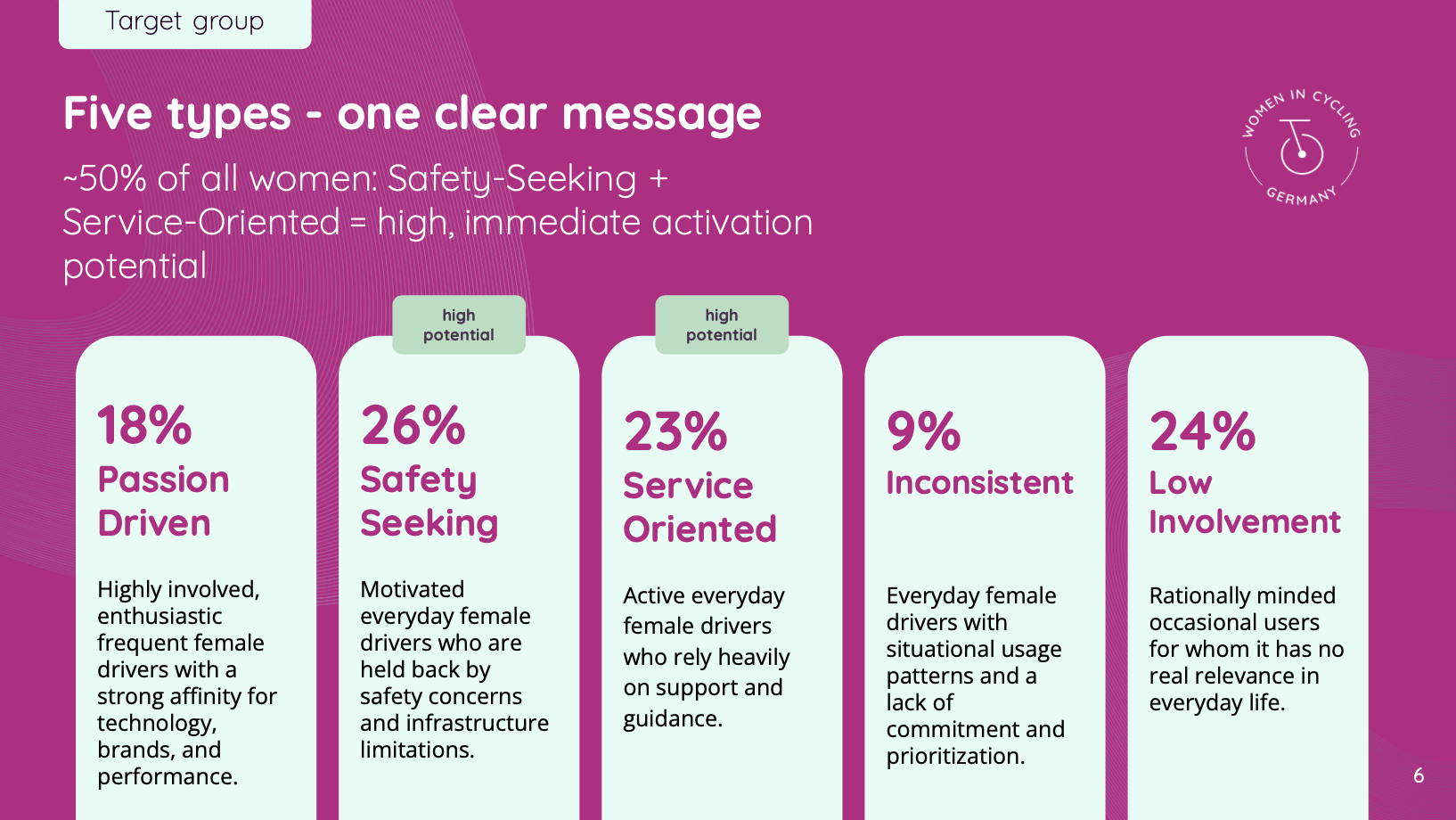
These women already use bicycles or wish to use them more often, but encounter barriers that limit their engagement. This is precisely where the greatest growth opportunities lie for manufacturers, retailers, and service providers.
The Levers Are in the Industry’s Hands
The study makes clear that the identified growth potential does not depend on external factors, but can be actively unlocked by industry and retail. The key levers lie in clearer communication, lower barriers to entry, stronger alignment along the customer journey, and a consistent focus on safety and real-life usage situations.
Specialist retailers play a pivotal role: women rely on personal recommendations, advisory conversations, and trusted contact persons to a greater extent than the average. Trust, orientation, and individual support are frequently more important than technical specifications.
“The study also points to a larger horizon: if women in the bicycle market were to reach a comparable level of consumption to men, this would already translate, in theoretical terms, to an additional market volume of 3.3 billion euros. This potential spans bicycles, accessories, apparel, and services, and underlines the economic significance of female target groups for the future of the industry,” summarises Katja Richarz, Project Manager Customer Relationship & Retail First, Eurobike.
Four Areas for Action
The study identifies four central action areas for industry and retail:
• Communicate safety more prominently: Safety is a decisive purchasing criterion for many women. Safety features should be presented not as technical specifications, but as concrete, everyday benefits.
• Strengthen specialist retail as an anchor of trust: Women rely on personal advice and recommendations to an above-average degree. Retailers can unlock additional potential through individual service, community offerings, and long-term customer relationships.
• Think bicycle, accessories, and service together: Significant revenue potential lies across the entire customer journey. Advice and offerings should present bike, accessories, maintenance, and service as an integrated solution from the outset.
• Make leasing more visible and accessible: Many women are unaware of existing leasing options or have yet to make use of them. Employers and leasing providers can unlock additional demand through better information and more flexible models.
Women in Cycling Germany says its aims are not only to make these findings visible but to develop them further in collaboration with industry and retail. Building on the study results and expert interviews conducted, concrete guidance documents and best-practice approaches are to be developed that will support companies in systematically unlocking the identified growth potential.
The study acknowledges that it cannot yet fully evaluate which specific measures will generate the greatest impact. This is precisely where Women in Cycling Germany sees the need for further research – working with industry, retail, and other stakeholders to investigate the identified levers in greater depth and translate them into practical recommendations.