
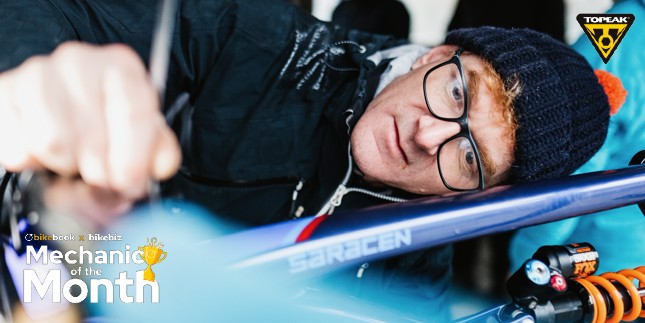
In 2025, we launched ‘Mechanic of the Month’ in partnership with bikebook to champion bicycle mechanics around the UK.
We now have additional support from Topeak, who agreed to support the initiative by offering Topeak tools and best trade pricing across the Topeak Tools/Workshop range (via Extra UK) for 12 months.
Nominations are open to the public via bikebook, allowing anyone to nominate their favourite mechanic.
Here we chat to our most recent winner, Richard Keates from Ginger Rick Pro Bike Mechanic
Walk us through your journey into the world of bicycle mechanics. What initially sparked your interest in the job, and how did you get started?
It’s a very long story! I’ve loved tinkering with bikes from an early age. I went on to become an engineer and then a mechanic for North West Mountain Bikes in Manchester, before moving into youth work, using cycling and bike mechanics as a way of engaging and teaching them.
I’d also been racing downhill since the 1990s. I stopped racing in 2008 because of an injury, but I still wanted to be involved in the race scene, so I started providing a free mechanic service at the Pearce Cycles Race Series, and later at the British Downhill Series with Si Paton.
That eventually led to me setting up my own bike mechanic business and being asked to work at the Downhill World Championships for British Cycling, followed by working as a World Cup and development team mechanic for Saracen.
So I suppose my route into mechanics has been a mixture of racing, engineering, youth work and simply being obsessed with bikes!
Tell us about your current role and where you work?
I’m currently the owner and mechanic of Ginger Rick Pro Bike Mechanic, a mobile bike mechanic service covering Cheshire. I also service bikes for Greater Manchester Police, and I continue to work as a mechanic for Saracen/Madison and British Cycling.
Alongside that, I work with Target Composites, a carbon frame repair company, and I also teach basic bike mechanics, which is something I really enjoy.
What does a typical day look like for you in terms of the bikes and jobs you most often encounter in your workshop?
There isn’t really a typical day, which is one of the things I love about the job, and a challenging repair is something I really enjoy. That can be a simple matter of having extensive knowledge of the components, but sometimes it means engineering parts to make them work better.
I carry out general repairs and servicing on all types of bikes, but I’m increasingly doing race set-ups, troubleshooting and giving advice to a growing number of young racers.
A big part of my job is understanding what the rider actually needs from their bike, rather than simply fixing the problem in front of me. With young racers especially, small changes to a bike or their set-up can make a huge difference.

In your opinion, what is the most important, or perhaps misunderstood, aspect of a bicycle mechanic’s role?
For me, it’s the ability to teach the customer how to look after their own bike.
When I worked in bike shops, I didn’t always have much direct contact with the customer. My role is much more one-to-one now. I can explain what I’ve found, why something has happened and what the customer can do to prevent it happening again.
I think customers really value that knowledge and personal approach. A good mechanic shouldn’t just fix a bike — they should help the rider understand it.
Do you feel mechanics receive adequate recognition for their expertise and the value they add?
I think I’m probably lucky in that respect because of my experience on the World Cup circuit and my involvement in developing young downhill riders, several of whom have gone on to become World Cup winners.
My customers really appreciate the advice and experience I can bring, particularly when it comes to setting bikes up to the rider.
That said, I think the wider industry could probably do more to recognise just how much knowledge and skill a good mechanic brings to a bike and its rider.
Do you have a favourite tool you can’t live without, or a particular type of job or repair that you find most satisfying or challenging?
If you asked Will Longden, the Saracen and Madison manager, he’d probably say my hammer!
But really, the most satisfying part of any job is seeing a customer leave happy because their bike is working better than it ever has before.
I particularly enjoy the jobs where you have to diagnose a problem that isn’t immediately obvious. Finding the cause, fixing it and then seeing the difference it makes to the rider is hugely satisfying.
Are you using Bikebook? If yes, what’s your experience been like?
Yes, I’m on Bikebook, but I’m very new to it.
So far it’s been working really great, and it’s helping to increase my customer base.

Beyond the practical skills, what do you believe are the most important qualities that make someone a great bicycle mechanic?
Honesty and passion.
You have to genuinely care about bikes and about doing the job properly. In my case, you could probably say I’m obsessed!
You also need to be honest with customers. If something doesn’t need replacing, don’t replace it. If something is unsafe, fix it. Building that trust is just as important as having the technical skills.
How important have formal qualifications or continuous learning been in your development, and what are your thoughts on their value in the industry?
Being dyslexic, I’ve always found formal qualifications and classroom-based learning quite challenging. I learn much better by getting my hands on something and working it out.
I am a Cytech-qualified mechanic, but I find it frustrating that gaining qualifications can be difficult unless you’re already working in a shop. At the same time, it can be difficult for a young person to get that first opportunity in a shop without qualifications or experience.
That’s something I’d really like to change.
I’m looking into setting up a training school because through my work as a youth worker, I’ve met lots of young people who want to become bike mechanics but simply don’t have access to the bikes, tools or facilities they need to practise.
There’s a huge amount of potential talent out there. Sometimes people just need someone to give them that first opportunity.
What changes in trends, bike technology, or rider culture have you seen during your time as a mechanic? How have these shifts impacted your work and the skills required?
I’ve been around bikes all my life, so I’ve seen an enormous amount of change.
The biggest recent change for me has been the huge growth in e-bikes, which has had a significant impact on my workload. Getting to grips with the technology and understanding how the different systems work has been a challenge, but it’s also important to keep learning and adapting.
We’ve also seen constant changes in wheel sizes and geometry, as well as the move towards fully internal cable routing. From a mechanic’s point of view, that can make what used to be a relatively simple job considerably more complicated!
The industry is constantly evolving, so you can never really stop learning.
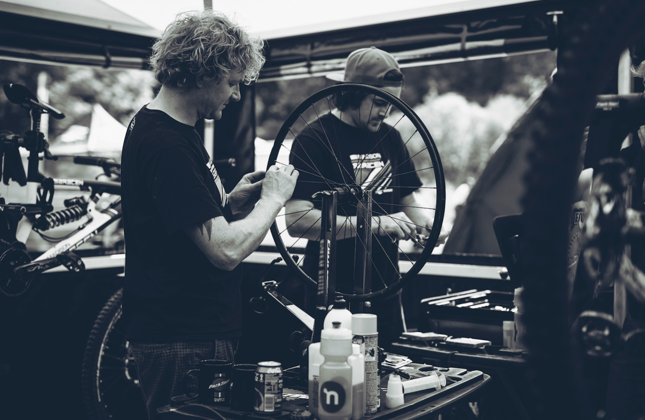
What advice would you offer to someone who is just starting out or considering a career as a bicycle mechanic? What have you learned that you wish you’d known when you first began?
Especially for a young person, I’d say find yourself a Saturday job in a bike shop and make yourself indispensable. Whatever job you’re given, do it to the best of your ability.
Don’t be scared of taking your own bike apart. You’ll make mistakes — everyone does — but you’ll learn from them. That hands-on experience is incredibly valuable.
And finally, get yourself a good workstand. It’s one of the best investments you can make when you’re starting out!
Follow Rick on Instagram to keep up to date with his work.
