

This piece first appeared in the August 2026 edition of BikeBiz magazine – not subscribed? Get a free subscription.
By Fi Spotswood and Claire Sharpe
If you’re looking for growth in the mountain biking sector, you don’t need to look very far.
Across the UK, women are quietly organising themselves into a different, thriving version of mountain biking.
Not a separate sport, but an alternative culture.
It’s a version built around collaboration, community and confidence. Around women introducing other women to riding, bypassing pre-existing cliques and outdated hierarchies. It’s where women ride together, support each other and progress. It’s a version fostered through grassroots organisations, local communities and woman-led businesses that have spotted an opportunity and are moving quickly to meet it.
The growth is hard to miss if you look.
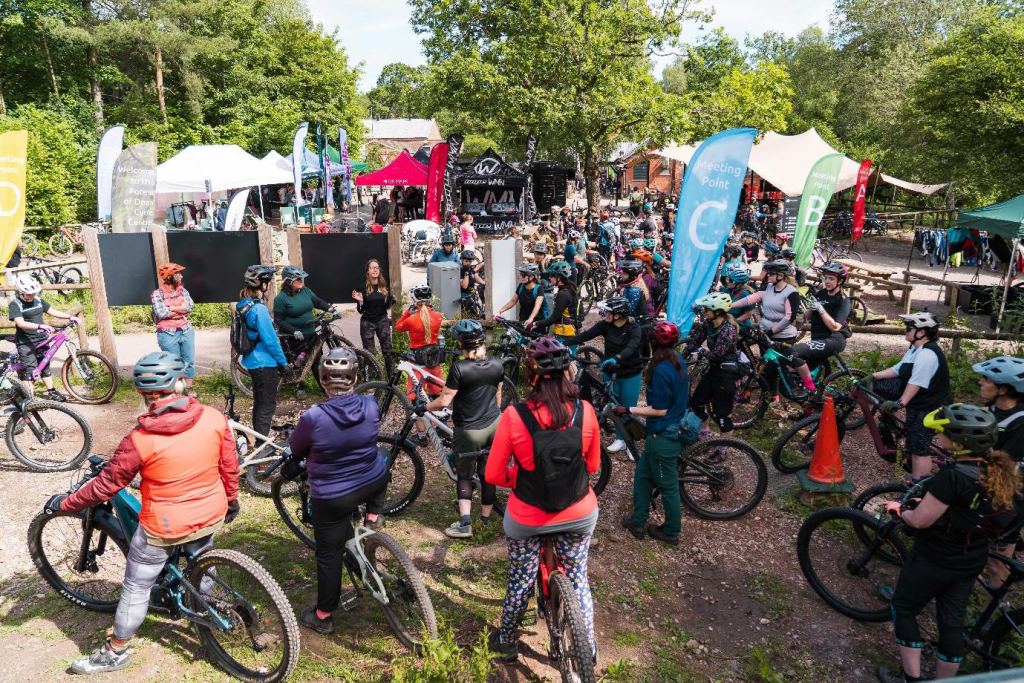
Women’s rides fill up. Coaching sessions sell out. Female-focused festivals, events and holidays continue to expand. Organisations such as Sisters in the Wild, Girls That Ride Bikes and AllTerre have built thriving communities of off-road riders who are women and marginalised genders (women+), while dozens of small local groups and women+ entrepreneurs are creating pathways into the sport for women+ and girls that simply didn’t exist a decade ago. Kath Goodey, mtb guide and coach at RideHigh MTB in North Wales, explains that “women make up over half my followers, and make up the majority of my customers on guided rides and weekend adventures. The women’s market is growing year on year”.
But women have a different relationship with mountain biking than men. They face different challenges and value different aspects. Many discover mountain biking later in life. Societal gender norms still patterns what men and women do in their childhoods, work and leisure time. Heather, CEO of She Rides, which offers women-only coaching, holidays and social rides, emphasises that “Women don’t have the same histories in mountain biking as men, and don’t necessarily ride in the same way or for the same reasons. Their lives outside mountain biking are different. They want products, services and media that are tailored to them.”
Research from Project FIAS shows women hunt around to find media stories and brands that help them connect with the sport, but that this can be a struggle. When women+ look at mountain biking’s marketplace, women+ don’t always see their experiences, bodies, or values reflected back.
Too often, the dominant image of mountain biking remains rooted in a culture that has historically been shaped by men and for men. Despite the clear efforts made by some brands, writers and publishers to create alternative, diverse narratives, often the stories and images we see representing our sport are limiting and narrow. They reflect a sport dominated by highly experienced riders, technical expertise, performance, racing and increasingly extreme riding. “You have to be a white woman performing amazingly to be featured”, explained one of the FIAS research participants, Sammy. She went on to explain that mountain biking “marketing and media seems to be designed to make us women feel like we aren’t good enough because we don’t ride by men’s standards”.
What is happening at grassroots level suggests that mountain biking is evolving faster than many of the brands and media organisations that serve it.
That’s not simply a representation issue. It’s a marketing opportunity.
Gearing Up!
Gearing Up! is an actionable framework for brands to understand the version of mountain biking that women+ are currently building for themselves and how they can authentically become a part of it. It is underpinned by research from Project FIAS – interviews with women+ and people of all genders working across the industry. It provides a pathway, via four ‘gears’, to adapt and seize the commercial opportunity currently sitting on the table.
That sounds straightforward enough. In practice, however, many organisations struggle to know where to begin. The cycling industry is full of people who recognise the opportunity. Ask most brand managers, editors, retailers or event organisers whether they would like to engage more women+ and the answer is usually an enthusiastic yes. But there’s a fear of getting it wrong, fear of being tokenistic, fear of alienating the strong male customer base, fear of doing things differently within the current challenges of budgetary cuts and industry squeeze. And there’s a genuine challenge in connecting with women+ when marketing teams are entirely made up of men.
The result can be paralysis.
Gearing Up! was developed to break that deadlock.
Rather than presenting inclusion as a communications exercise, a campaign or something to outsource to a PR agency, it treats it as a business opportunity that requires a structured, reflexive response. Importantly, it does not start with media content.
It starts with women.
The first gear is Strategy.
This is where organisations establish the business case, not the moral case. Where are women+ customers currently being turned off or lost? What audience opportunities are being missed? If women represent 20% of riders but only 5% of your customers, what would closing that gap mean for your business?
The strategy gear is also about establishing who owns the work internally and thinking about how success will be measured. Gearing Up! can’t be left to ‘the women’, or to one keen chap with a bit of an interest. It has to be an internal, strategic commitment.
The second gear is Insight.
Here, organisations move beyond assumptions about women+ that have driven prior campaigns and start interrogating evidence. They examine audience behaviour, listen to women+ riders, identify blind spots and explore how stereotypes may still be shaping products, content and communications. The aim is to replace opinion with understanding and ensure decisions are grounded in data.
[Understanding a bit of the history of women+ in cycling also helps ground organisations’ thinking and where women are coming from. Did you know that in the 19th century, (male) doctors responding to the moral panic associated with women riding bikes warned ferociously about ‘bicycle face’, an unpleasant malady associated only with women who pedalled bicycles].
The third gear is Operations.
This is where the focus turns inward. It can be a bit uncomfortable putting the gender dynamics of your own organisation under the microscope, but it’s important to do. When diverse teams devise a marketing strategy, different voices are heard. In gear 3, organisations think about who makes decisions, whose voices are included and what processes are reinforcing the status quo or allowing diverse stories to emerge.
Improving representation in marketing often starts long before a campaign is created. It starts with the people shaping the work and the perspectives they bring to it.
Only then comes the fourth gear: Activation.
This is where insight becomes action. This is where content plans, campaigns, marketing investment, event ideas, brand launches and media planning are reviewed and planned differently. Partnerships are reconsidered. Campaigns evolve. Women appear not as tokenistic additions in adverts, but are included in content – and content production – as experts, leaders, testers, coaches, adventurers and protagonists. Activation also includes supporting initiatives that drive participation and increase the market from the bottom up. Sponsoring FLINTA (female, lesbian, intersex, non-binary, trans and agender) only events, girls clubs, and women racers can all be part of driving a gender inclusive culture and boosting the future market.
The objective is not simply better representation but stronger engagement, increased participation and ultimately commercial growth.
Taken together, the four gears create something that is often missing from conversations about gender inclusion: a practical route forward.
Gearing Up! is not a quick fix. It’s not about developing a one-off campaign or adding a badge or pledge to the website. It’s a process for understanding an audience, identifying opportunities and building a business that is better aligned with where mountain biking is heading – a truly open sport.
Project FIAS
Project FIAS (Fostering Inclusive Action in Sport) is a funded research and impact project based at the University of Bristol Business School. It explores how inequalities shape participation in sport, publishing peer-reviewed works with public sector, policy, and industry partners to develop practical, evidence-based tools that help create more inclusive sports cultures and opportunities for growth.
Dr Fiona Spotswood
Dr Fiona Spotswood is Associate Professor in Marketing and Consumption at the University of Bristol, where she conducts research into sport and physical activity participation, cultures of exclusion and behaviour change. She is an internationally renowned author and public speaker on gender inequality, action sports and social change, and heads up Project FIAS. She is also board member of the European Network of Outdoor Sports, Ride Bristol trail association trustee, leader of Bristol Shredders children’s mountain bike club and a qualified mountain bike guide and coach.
Claire Sharpe
Claire Sharpe is a brand strategist with 15 years’ experience across micromobility, FMCG, and active travel. She heads up Studio Esker, a brand strategy and marketing consultancy specialising in the cycling and outdoor industries. She is also active on the bike, as founder of AllTerre and The Bristol Rally. She is a Level 3 MTB Guide and Coach, MTB Guide trainer, and an off-road ambassador for Canyon.
Gearing Up!
Gearing Up! is free to download as a short checklist designed to drive conversations and commitment, and motivate action. For those wanting more, a full workbook is also available that can guide more in-depth internal discussions, critical assessments and organisational engagement. Scan the QR Code for more information.


