
This piece first appeared in the June edition of BikeBiz magazine – not subscribed? Get a free subscription.
By Matt Dowler, CMO – BatteryIQ & Boost Bikes
I’ll start with some good news: there is a real opportunity in the UK for micromobility to grow rapidly, and there’s a strong appetite to swap four wheels for two in urban settings.
BatteryIQ recently commissioned a survey of 2000 UK adults to understand attitudes to e-bikes. We were amazed at the strength of positive intent. Unfortunately, the survey also identified some significant barriers to e-bike adoption, which the industry must address if we want to see European-style mass adoption of e-mobility in the UK.
The stats showed that 22% of people were “somewhat interested” in owning an e-bike, and 16% were “very interested”. Even more surprising was how many people hope to swap the car for a bike around town. Of those interested in e-bike ownership, 56% said it could replace all car journeys under five miles, with a further 28% indicating they would replace some short journeys. I’m particularly excited about the potential for e-bikes to take a significant share of urban journeys, given the public health benefits of active travel.
Only 5.5% suggested an e-bike would be used solely for leisure riding, meaning the industry’s focus on E-MTB reaches only a small portion of the potential market – what an opportunity!
All very positive so far, but this is where the story changes, with two main barriers to e-bike ownership clearly coming through: battery safety and cost.
Battery Safety
There’s a prevailing narrative in the bike industry that battery fires are not caused by good-quality products from known brands. The statistics from fire brigades generally support this view, and it has been recognised by government in the APPGCW’s inquiry on “The Threat of Illegal E-Bikes”. However, this is not the message reaching the general public.
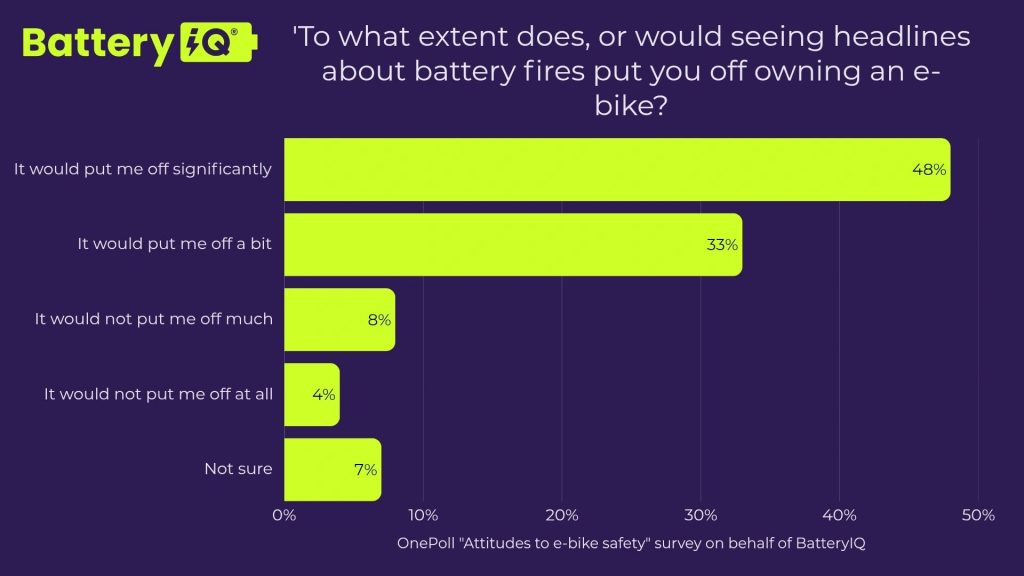
Whether you agree with it or not, e-mobility batteries have a bad reputation, and potential customers are being put off because of perceived risks. We’ve all seen headlines reporting “e-bikes” causing fires, and so has the general public. 75% of people had some awareness that e-bike batteries can cause fires. Depressingly, 48% said they would be put off e-bike ownership “significantly” by such headlines. A further 33% would be put off “a bit”, meaning 81% of the public are put off buying an e-bike by battery fire reporting.
Those who do invest in good-quality e-mobility are finding increasing restrictions on where they can use and charge their products. Because it’s not possible to prove any battery is safe, the easiest response to reduce risk is an outright ban. Just buying a “known” brand is not enough – you can’t expect a building manager or a TfL employee to identify a safe battery with no detailed bike knowledge. This affects legitimate e-bike owners just as much as those using less conventional supply chains, and risks deflating the enthusiasm for active e-travel we’ve identified.
Pricing vs Perceived Value
The other barrier to e-bike ownership that the survey picked up is simply cost. People’s perception of what a good quality e-bike should cost is significantly different from what is available from known brands and reputable bike shops the “E-Bike Positive” campaign rightly promotes.
31% of people think that a good-quality e-bike costs less than £1000, which helps explain why there is such a big market for super-budget bikes or dodgy conversion kits from online marketplaces. This appetite seems persistent in spite of people’s awareness of the risks e-bike batteries can pose. If you try to shop in this price range from reputable brands or retailers, the pickings are slim indeed.
A further 11.7% identified £1001-1500 as their price point, 10% chose £1501-£2000, and only 12.6% thought over £2000. Take a look at where the majority of models from conventional brands are priced, and the discrepancy is clear.
The proliferation of direct-to-consumer brands selling affordable folding, compact and cargo style bikes is further evidence of the opportunity outside expensive sport-focused models. There’s a real risk that the “legacy” bike industry gets left behind by new players who cater better to the needs and budgets of mass-market mobility customers. The opportunity is there to be missed!
(35% said they didn’t know what an e-bike should cost—unsurprising given that 39% are not interested in owning one.)
So, what can we do about this?
Bike cost and product positioning are within the industry’s control. If brands focus on what potential new customers want to use bikes for, there might be less need for the latest 13-speed groupsets and 100+ Nm motors, which would significantly reduce prices. Don’t get me wrong, I love the latest gear on my bikes. There will always be a market for the enthusiasts, but recent years have shown there are only so many people who’ll buy the “latest thing” on repeat to keep inventory moving. The quality of lower-level components has improved dramatically in the last decade, and a bike that works well and lasts a long time needn’t cost the earth.
Battery safety is a more difficult problem. We can call for robust secondary legislation under the new Product Regulation and Metrology Act, and for better enforcement against online sellers who flout the legislation, but that will take time to have an impact, and will not remove existing substandard products already in use. Unfortunately, further fires from these products are inevitable. This is the reality facing stakeholders deciding whether to allow e-bike use. Ultimately, e-bike bans are likely to continue unless we do something proactive, and we run the risk of a transition to e-mobility and active travel in our cities being thwarted before it builds real momentum.
Kitemarks and labels are easily faked. Lists of safety-audited brands are likely to reassure customers at point of purchase, but it’s not practical or cost-efficient for people with no bike knowledge to check individual bikes to allow them into buildings or onto trains, etc.
I’ll obviously advocate for the work BatteryIQ is doing to monitor batteries remotely with smart BMSs and asset tagging to give stakeholders visibility of batteries and their health, but there are other companies looking at solutions too. Powershelter is one example leading the charge (pun intended) on charging lockers which keep batteries in safe spaces whilst charging and at highest risk of thermal runaway.
If we want to seize the opportunity e-mobility presents in the UK, it’s not enough to say “e-bikes from known brands are safe” and hope the message lands. We need to do more.
Survey info:
The survey was conducted by OnePoll on behalf of BatteryIQ between 5th and 11th March 2026 and questioned 2000 UK adults, comprising a nationally representative sample.