
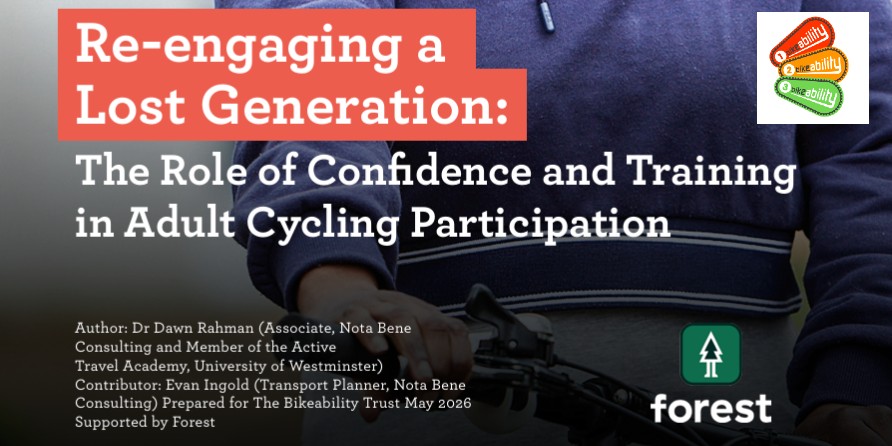
A new report published this week by The Bikeability Trust reveals a ‘lost generation’ of adults who lack the skills and confidence to cycle, with three-quarters not having cycled at all in the past year.
Despite a rising interest in cycling for health, climate and cost savings[1], the new report Re-engaging a lost generation: the role of confidence and training in adult cycling participation, identifies a ‘lost generation’ of adults who missed out on cycle training as children, falling in the gap between the decline of the cycling proficiency programme and the introduction of Bikeability.
Adult cycle training remains fragmented, inconsistent and poorly measured – but Bikeability offers a national gold standard, guaranteeing safety, consistency and accountability wherever training is delivered. With sustained Government investing in active travel and centralising adult training through Bikeability, we can provide robust data and outcome tracking to show the return on active travel investment.
“Confident cycling is one of the most effective tools we have to tackle transport poverty, giving people a safe, low-cost and healthy way to get to work, school and services. But people need a clear, trusted pathway to become confident riders. That’s what CycleIn is about: giving people the skills to use the infrastructure we have – Emily Cherry, CEO Bikeability Trust
The new research, based on a YouGov survey of more than 2,000 UK adults, shows that cycling among adults remains low and is overwhelmingly fitness and leisure-focused. Only 36% of adult cyclists do so regularly for everyday journeys such as commuting or school runs.
Survey findings also indicate that women are substantially less likely than men to report feeling confident cycling in traffic, navigating junctions, or dealing with unexpected situations. This suggests the gender gap in cycling participation (men are more than twice as likely to cycle as women) is not driven by ability or infrastructure, but by differences in confidence in real-world traffic conditions – with the report recommending adult cycle training as the solution.
Formal cycle training remains strongly associated with childhood, and adult training remains rare, with fewer than 1% of non-cyclist survey respondents having taken adult training. Only 5% of those who currently cycle reported that they had taken training as adults, with interviewees indicating that it is this lack of training that limits their confidence and reasons to cycle, limiting them to traffic-free routes for leisure rather than transport.
Meanwhile, Forest’s own data found that shared e-bikes are a catalyst for cycling, as almost 80% of users cycle more than they did before discovering Forest.[2]
The report is being launched on Thursday at a reception at the Houses of Parliament – bringing together MPs and active travel leaders to make the case for adult cycle training through additional investment.
Agustin Guilisasti, CEO and Co-Founder of Forest, said:
“It’s been incredibly encouraging to see first-hand how e-bikes are helping more Londoners choose cycling for everyday journeys, making sustainable transport more convenient and accessible than ever before. But increasing cycling participation isn’t just about putting bikes on the road; it’s about ensuring people feel comfortable and confident every time they ride.
“This new data points to a wider challenge in the industry: a ‘lost generation’ of adults who have missed out on developing the confidence to cycle in urban environments. That’s why Forest is investing in rider education, safety initiatives and accessible training programmes to help more people build the skills and confidence they need to cycle regularly.”