A representative study of 25,000 people across Europe found that 121 million people are cycling less because they have difficulty accessing bicycle repair and maintenance services. The polling, undertaken by Shimano, was conducted as part of its State of the Nation Report for 2025.
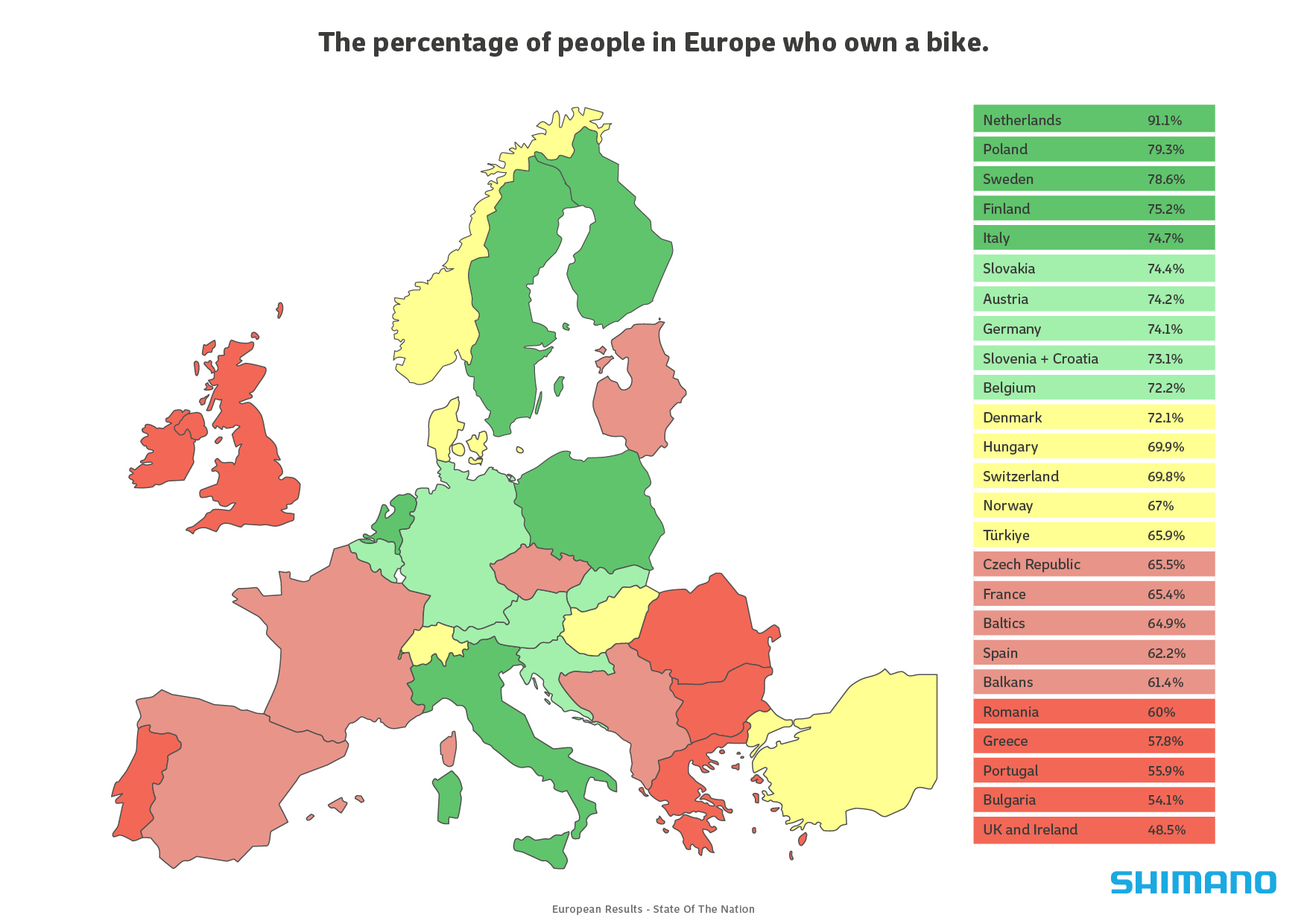
The new data has found that the UK and the Republic of Ireland have the lowest bicycle ownership rates in Europe. 87% of people said they have ever owned a bike (the lowest in Europe), and that drops to an extraordinary 48.5% who say they still do (again, the lowest in Europe). For comparison, 65.4% of people in France own a bike, and 74.1% in Germany. People do feel that their local cycling infrastructure is improving, with 47% of people saying that they have seen progress in their local area within the last year.
The report sought to understand how people in Europe view cycling infrastructure, children’s safety in cycling, and the quality and availability of bicycle maintenance and repair. This is the fourth edition of the State of the Nation report, which started in 2020.
25,000 people across more than 25 European countries and regions were surveyed for Shimano’s State of the Nation Report, enabling robust cross-country comparisons to identify both progress and gaps. The report aims to provide evidence-based insights that empower advocacy groups and policymakers to drive meaningful change and bring under-researched barriers and issues related to cycling into the public debate.
Bicycle Maintenance
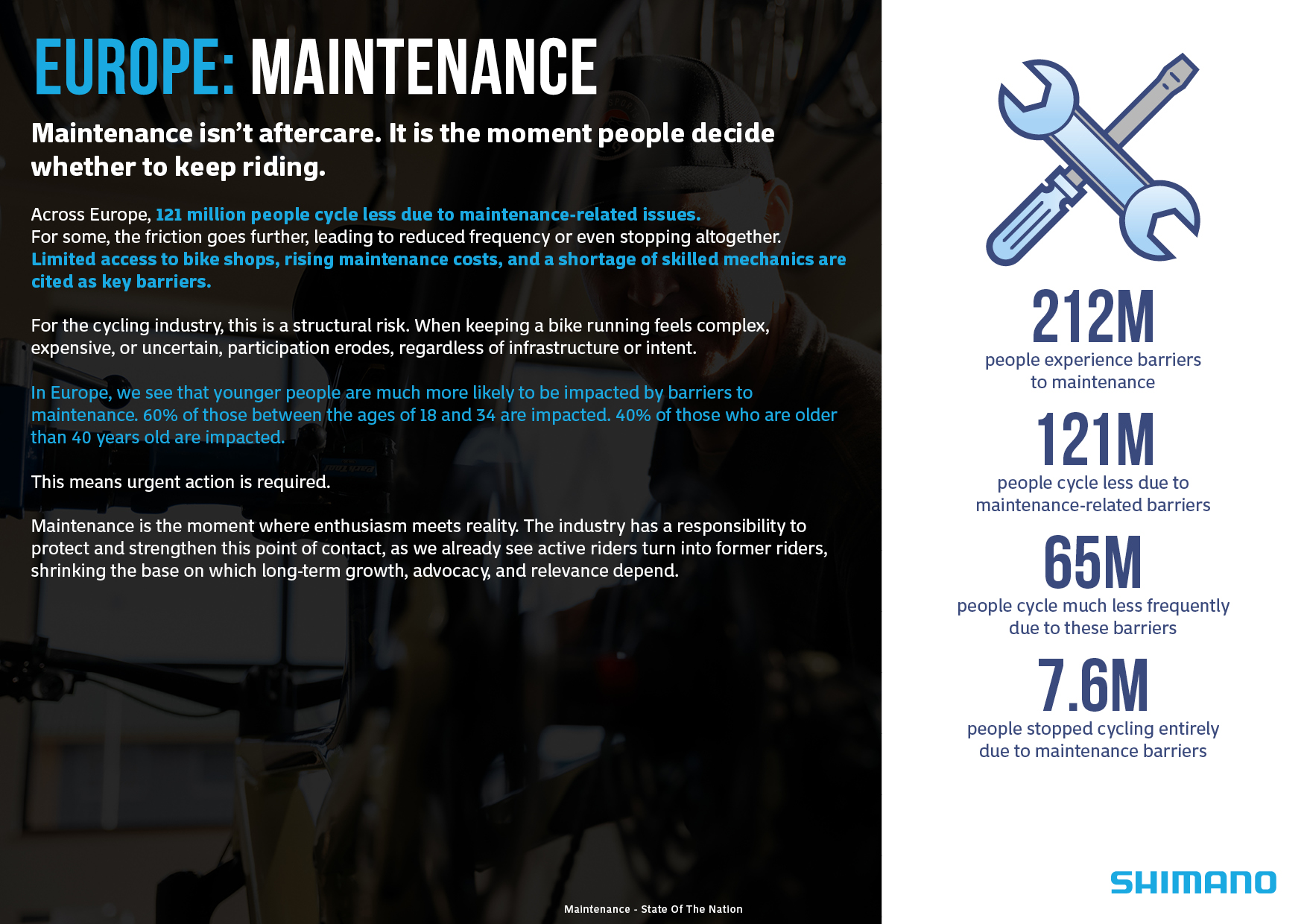
Researchers asked about difficulties people may experience in accessing bicycle maintenance or repairs, and what the impact of these has on their cycling behaviour. Concerningly, an estimated 212 million people experience barriers, with 121 million people across Europe saying that they cycle less due to maintenance-related issues. Of these, 65 million cycle significantly less (between 25% less to completely stopping).
In the UK and Ireland, 40.9% of those who have ever owned a bike experienced barriers to maintenance. While this percentage is lower than in Southern and Eastern Europe, the specific nature of the barrier points to a capacity issue.
27% of respondents in the region cited long waiting times at bike shops as a primary reason for difficulty. This is significantly higher than the European average, suggesting that the number of skilled mechanics and workshop slots has not kept pace with demand.
Almost half of people across Europe who own or have owned a bicycle said they experienced issues, 20.3% said that they did due to high costs, 15.3% due to a lack of local bicycle shops or difficult opening hours, and 11.8% due to long waiting times.
Of those who did experience barriers, 26.9% said they tried to fix the bike themselves, 21.8% said they relied more on other forms of transport, 20.7% said they cycled less frequently, and a worrying 16.4% of people said they stopped cycling altogether. These findings highlight a structural risk to cycling in Europe, when keeping a bicycle running feels complicated, expensive, or inconvenient – it can have a significant impact on continued participation.
Children’s Safety
Across many European countries, people feel that progress on children’s cycling safety is stalling or going backwards. This stagnation poses a long-term risk to the cycling industry. Children who do not feel safe cycling are less likely to develop riding habits that carry into adolescence and adulthood, reducing future participation.
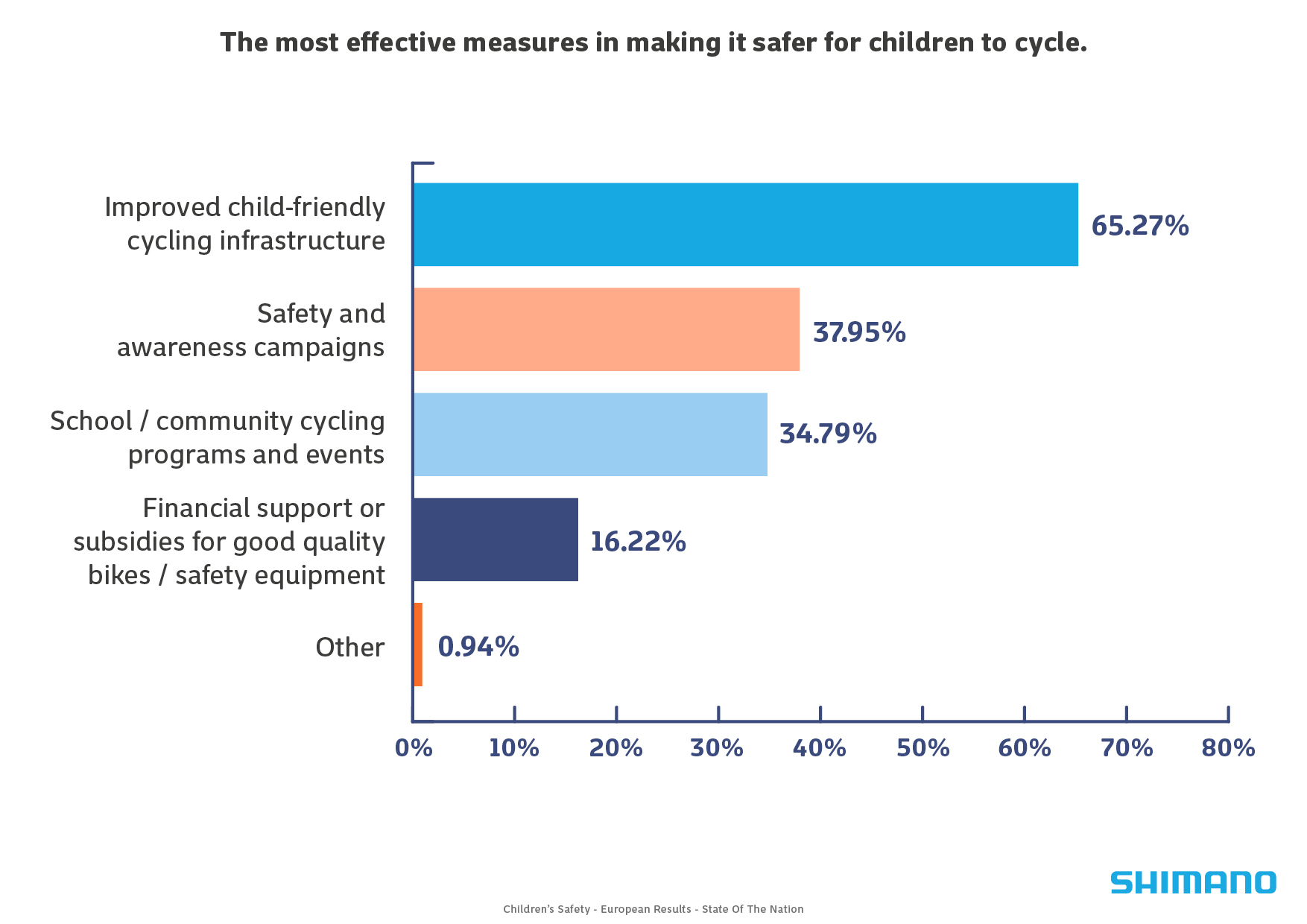
Less than two-fifths of respondents across Europe report that cycling has become safer for children over the last twelve months. When looking at the net difference between those who agree and those who disagree in response to the statement: ‘’It has become safer for children to cycle in my local area in the last 12 months’’; Poland comes out on top with +41.0%, and Greece has the lowest with -28.1%. Surprisingly, the Netherlands has a net negative of -22.7% – possibly due to issues around the rising use of so-called “fat bikes” on cycle lanes.
In the UK and Ireland, perception of child safety is moderately positive, with a net difference of +7.3%. 70% of respondents cite improved infrastructure (such as segregated lanes and low-traffic neighbourhoods) as the main reason it has become safer for children to cycle. This is an exceptionally high attribution rate, suggesting that the public clearly links physical road changes to the safety of young people.
When asked what measures their local area should prioritise to improve children’s cycling safety, people across Europe selected child-friendly infrastructure as the primary focus. This was overwhelmingly the case, both for respondents who felt that children’s cycling safety had improved, and those who did not.
Infrastructure
This year’s report finds that there is substantial disparity across Europe between countries when it comes to people’s perceptions of cycling infrastructure. Participants were asked for their level of agreement with the statement “The cycling infrastructure has improved in my local area in the last 12 months’’.
Again, looking at the net difference between those who agree and those who disagree within individual countries, Poland (+47.7%), France (40.2%) and Finland (33.1%) rank highest, whilst Greece (-18.8%), the Czech Republic (-17.8%), and Bulgaria (-4.7%) rank the lowest. The Netherlands (+4.1%), Belgium (+8.9%) and Denmark (+7.6%) are all within the bottom seven countries. With all three long regarded as cycling pioneers, it will come as a shock to many that they rank so poorly. However, this disparity reflects not failure, but expectation. In mature cycling markets, people become accustomed to good infrastructure, and their standards continue to grow.
For the industry, this presents a clear challenge: when leading markets lose momentum, they can also lose their role as reference points for growth, innovation, and cultural leadership. If infrastructure in these countries fails to keep evolving, participation can plateau, ambition can soften, and cycling risks becoming a legacy mode rather than a dynamic driver of health, mobility, and everyday life.
47% of respondents in the UK and Ireland report that cycling infrastructure in their local area has improved in the last 12 months. This positive sentiment places the region ahead of traditional cycling nations like the Netherlands (36%) and Denmark (38%).

Ties van Dijk, Advocacy Specialist at Shimano Europe, said:
The State of the Nation report is a wake-up call for everyone who cares about the future of cycling in Europe.
We see millions of people who want to ride, but are being pushed away by barriers that should not exist, from the lack of availability and complexity of maintenance to concerns about whether it is safe for children to cycle.
‘Physical infrastructure is improving in many places, but this infrastructure alone is not enough. If we fail to make it easy for people to maintain their bicycles, and safe for the next generation to ride, we risk shrinking participation at the very moment when society needs active, sustainable mobility the most.
Download and read the full State of the Nation report.