
Friday, 13 December 2024: The date on which a significant European Union regulation change occurred —introducing the General Product Safety Regulation (GPSR)—seems to have caught more than a few by surprise.
In the week before GPSR went into effect, a flurry of last-minute questions—a number of which BikeBiz saw being asked on LinkedIn—highlighted a lack of awareness of its impending arrival.
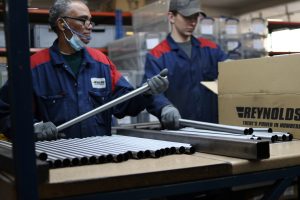
BikeBiz spoke with Martin Shepherd, GM of Reynolds Technology, to explore this critical-for-doing-business-in-the-EU change in greater detail.
22.01/2024 Updates:
BikeBiz has been informed by Irene McAleese, co-founder of See.Sense, that the “Department for Business and Trade are holding an information session https://www.great.gov.uk/export-academy/events/42-days-of-gpsr-what-do-we-now-know-24-january-2025/ on Friday, 24 Jan, which may be useful for businesses in the cycling industry to attend and ask questions.”
Following communication from LEVA-EU, a rectification has been made, replacing ‘nominated person’ as originally appeared, with ‘authorised representative’. A link to the follow-up article can be found at the foot of this feature.

Let’s open by saying we’ve been on a very, very, steep learning curve on this and for us it came as a bolt from the blue.
We had one of the companies that we deal with ring us up and say, “Have you heard anything about GPSR 2025?” This was probably about three weeks before the regulation was due to come into force. At that point, we kind of go, “What? No, don’t know anything about this.”
The result: We spent a very frantic couple of weeks trying to find stuff out around GPSR.
To be honest, that has probably been the biggest problem for us: Finding a concise list of what you have to do.
Who is affected by GPSR?
GPSR affects anyone importing into the EU, so it affects the USA, China, Japan, the UK—everyone. It applies to anything except food. Having worked with people in the food industry, to be honest, they are very good at this already. For those of us in manufacturing, it’s been a different journey.
The long and short of it is that you now have to prove that you are compliant with EU regulation GPSR if you are importing into the EU, and also into Northern Ireland.
What is the aim of the new GPSR regulation?
We understand that this aims to stop goods entering the EU market with no testing, no CE marking, and then no recourse back to manufacturers if/when something goes wrong: So, for example, an e-scooter or e-bike that isn’t type-rated, and bought from an online marketplace – a product that has no CE marking on it, no warranty, and no in-country post-purchase support.
This doesn’t just apply to e-mobility or micromobility solutions.
The thing that has been difficult to get to the bottom of is how it works for D2C and B2B – clearly, both apply to us. 20% of the stuff we sell in the EU goes directly to frame builders, who are companies by and large, but equally, we do sell some stuff to hobby builders who are essentially end customers.
For example, a lot of custom builders don’t ISO-test their frames. They don’t ISO-test their frames because each one is different – no two frames are the same. ISO testing, by its nature, pretty much tests a frame to destruction.
To be honest, in our industry, there are quite a few grey zones.
New regulations. A new learning process.
In terms of what documentation is required, and provided, one of the key problems has been that we have gotten used to selling into the EU directly from the UK, via websites, and other links (social media), and not needing to have somebody in the EU. This comes from the days when you used to have an EU distributor.
Using Reynolds as a case in point: We used to have two or three distributors in the EU. We had a French one, we had a Belgian one, we had an Italian one. Those days are gone. People are used to selling directly into the market without any real requirement to have anyone in the EU that’s working there.
Post Brexit some businesses haven’t seen a need to put that in place.
That’s where it – GPSR – kind of becomes a bit of a ‘my god… what are we going to do?’ thing. By the time you read this, Friday, December 13, 2024, is already a month in the rear-view mirror – yet how many in our global industry are still unaware?
How many are still unaware that if you ship goods into the EU you now have to have an ‘authorised representative’ within the EU – a person who will be your representative in case of problems i.e. a first point of contact?
Important to mention: This person has to be an EU resident.
Post-Brexit there were a number of businesses which, in the 6 to 12 months following, had gone through the process themselves, and began offering consulting services. Effectively ‘We’ve spent 12 months figuring this thing out: If you’d like, we can help you with that – for a cost’.
Do you see something similar happening here?
Yeah. There are already people who are offering to be the nominated person for businesses. The prices I’ve kind of heard are around about a thousand euros a year.
If you’re selling a reasonable number of bikes, bike parts etc into the EU, then that kind of makes sense. However, if your total sales into the EU amount to a few thousand pounds worth of goods, requiring an ‘authorised representative’ clearly becomes a prohibitive cost.
Reynolds has an EU subsidiary that we set up a couple of years ago because of the problems of shipping into Europe. They’re based in Portugal. For us, it was quite an easy decision.
The person who heads that up is going to be our authorised representative and he has now actually started doing that for three or four of our customers who also ship into the EU. So, he’s kind of acting in that role for a few of the smaller UK producers. He’ll be taking a retainer from those companies.
For Reynold’s authorised representative, it is fairly low risk – we sell steel tubes and, to be fair, the number that we actually sell directly to end customers in the EU is very small. Now, we also sell a lot of tubes into the EU for frame builders. On the face of it, this is still pretty low risk to be the responsible person.
Looking at other examples, if you’re selling fully built-up bikes, with any kind of battery – if you’re selling a fully built-up bike and it’s got Di2 on it or, something like that – then again, the risk is probably pretty low, and you’ve probably got a pretty good traceability, all the way back to Shimano or whoever would underwrite the warranty on a Di2 component.
Obviously, that’s not the case for a lot of the D2C, online marketplace sold, e-mobility products – your typical uncertified e-bikes and e-scooters (NB: eBay recently banned e-bike sales by private sellers.)
If you haven’t got that traceability back to the manufacturer, then it’s pretty clear that being the nominated person is probably a job you don’t want. When something goes wrong – that’s the bit that you have to be prepared for…
Still thinking this all sounds like something you’ll do yourself, that it’s all too much money to pay?
We’ve sought guidance – from someone else in the industry – because it’s pretty clear things can rapidly get fairly complex.
If you sign up for a 3rd party acting as your authorised representative, they have to group things into categories, and then charge per category.
- If you are making bikes that is one category.
- If you are selling accessories your categories could be clothing, water bottles, tyres, helmets, saddles etc – and you get charged per category.
Some businesses may have to choose the most profitable categories to sell and decide to restrict what they sell into the EU.
So, whilst GPSR has a clear upfront cost, and some new process complexity, it is – importantly – also a good thing.
Part of the challenge we’ve had is that unscrupulous importers have been bringing in non-compliant and illegal products in the e-mobility space. This should hit that hard.
Agreed. It feels, in a lot of respects, like the right thing to do. We value the protection of the market, enforcing standards, and protecting both quality businesses and the end customer.
I’d say our frustration with GPSR is the appalling (lack of) communication – It could have been communicated a hell of a lot better.
At least with Brexit, we got a whole lot of notification it was coming. We went through a huge learning curve. I fear this is, potentially, something similar.
Communication challenges – critical information is hard to find
In the lead-up to the 13 December 2024 deadline, there was nothing clear coming from the Department for Business, Energy and Industrial Strategy (BEIS). On the website, it was words to the effect of ‘We will be publishing guidance shortly’. How can that be, for regulation taking effect that same week?
I’ve reached out to our Chambers of Commerce in Birmingham – everybody’s scratching their heads.
In Reynold’s home city, we have The Birmingham and Solihull Export Support Programme – which launched on January 1, 2024, designed to support small to medium enterprises (SMEs) post-Brexit. We reached out to them and it was radio silence: They had nothing, despite this thing happening in less than a week (at that point).
This lack of available information has been the biggest problem: If we’d known about this six months ago, we’d have had time to do this methodically.
SME VS online giants – all are not equal
There’s a lot of stuff out there for people who are selling through Amazon or eBay or similar, that says ‘This is how you do it, this is what Amazon’s expectations are, and this is what you have to do’ – but that’s fat use, to be honest.
I spent hours and hours looking through documents and information from the UK Government, as well as from the EU, trying to pull stuff together from what’s written out there and what I found was so vague.
Now we’ve put serious time into this – we’ve been actively looking. This means we’ve come up with our nominated person. We’ve explored ‘What do we do with our nominated person?’ ‘Where do we document that?’ Surely there should have been something out there?
Our nominated person then read through the regulations and one of his comments to us: “It (GPSR detail) should be marked on the product.” Next, he’s asking, “How are we going to mark that on a steel tube – somebody’s name and address and telephone number?”.
We’ll put it on the invoice – although it remains unclear if this is enough to be compliant.
Now, we’re not too worried because we’re covered by our European distribution hub, but there are a lot of people who are much more concerned because they don’t have the same setup.
Here, I’ll also say that I’ve seen differing responses – not necessarily in the bike industry, but in a couple of other sort of craft industries. Some people are going ‘I’m not going to sell to the EU’. Some are going, ‘I’m just going to keep shipping anyway. What are they going to do?’ Crucially, here, we’re talking about what would be described as low-risk products.
Clearly, other people are now asking “Where do I find an authorised representative from?”
Of real importance – if you’re paying for an authorised representative – you want somebody who understands you and your business, not just somebody who’s going through a box-ticking exercise.
GPSR: An EU overview
“The General Product Safety Regulation (GPSR) is a new key instrument in the EU product safety legal framework, replacing (from 13 December 2024) the current General Product Safety Directive and the Food Imitating Product Directive.
“It modernises the EU general product safety framework and addresses the new challenges posed to product safety by the digitalisation of our economies.
“The GPSR requires that all consumer products on the EU markets are safe and it establishes specific obligations for businesses to ensure it.
“It applies to non-food products and all sales channels. The GPSR provides a safety net for products or risks not regulated in other EU legislation. This safety net function means that EU consumers are always protected against dangerous products, now or in the future.”
Readers can find out more about GPSR here.
Following communication from LEVA-EU additional GPSR detail is linked here.
For British-based businesses looking for UK government guidance the “Department for Business and Trade are holding an information session https://www.great.gov.uk/export-academy/events/42-days-of-gpsr-what-do-we-now-know-24-january-2025/ on Friday, 24 Jan, which may be useful for businesses in the cycling industry to attend and ask questions.”