FLIT is scaling up its ebike frame manufacturing in Cambridge using adhesive bonding techniques adapted from high-performance cars like the Aston Martin DB9 and Lotus Elise.
At a time when 99% of bikes sold in the UK are imported, FLIT designs, bonds, and assembles entire ebikes in Cambridge. The result is a 14.5kg folding ebike built for urban and rail commuters that is easy to carry, store and ride.
Bringing Manufacturing Back to Cambridge
The UK cycling market is valued at £1.9 billion, but almost all of the 1.7m bikes sold annually are imported as complete bikes or, at most, have some parts assembled onto imported frames.
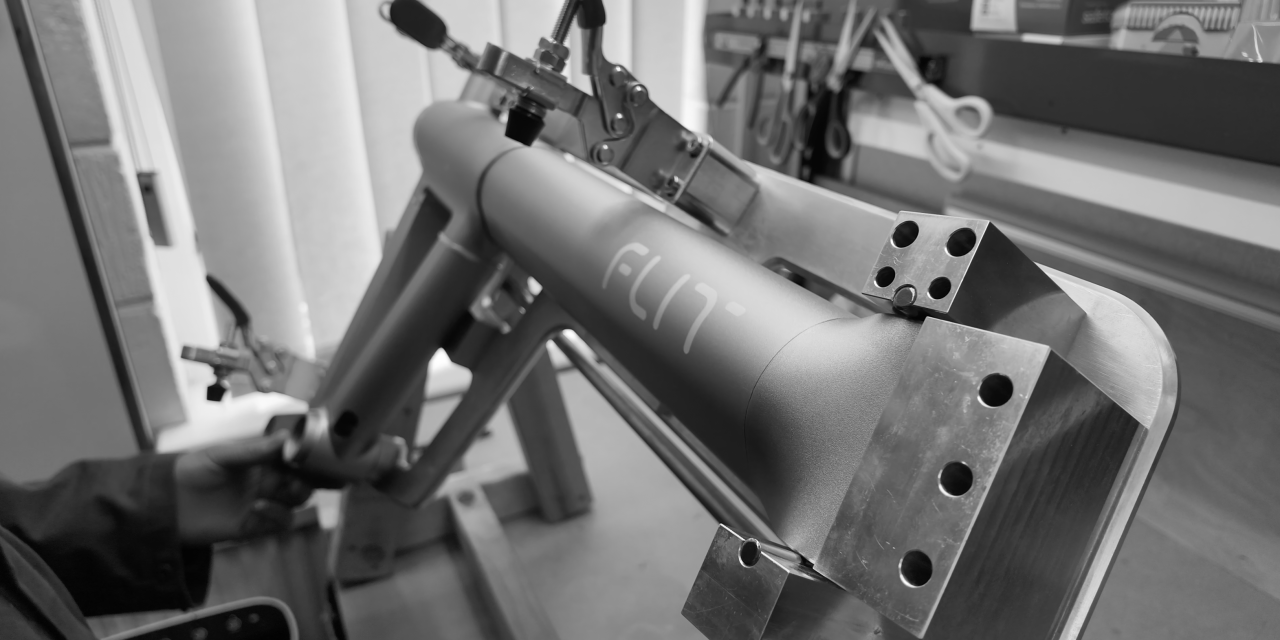
Developed and Bonded in the UK: Unlike some ‘Made in the UK’ brands that source pre-welded frames from international hubs, FLIT bonds precision parts into finished frames in its own facility.

Quality Control Oversight: This process ensures the accuracy of the frames, especially critical on a compact folding bike where parts must click together precisely. Quality control remains strictly under the direct supervision of FLIT’s Cambridge team.
Validated Innovation: This specialised adhesive bonding process was developed with support from grants by Innovate UK, the Royal Academy of Engineering, and the Advanced Propulsion Centre to help translate the process from the automotive and aerospace industries.
The Science of Adhesive Bonding: From Lotus to FLIT
FLIT uses adhesive bonding, a manufacturing technique developed for high-performance automotive engineering, to build its folding ebike frames.
The approach was pioneered on cars like the Lotus Elise, and is now widely used in vehicles from Aston Martin to Tesla, as well as in aerospace applications where precision and weight are critical.
Unlike welding or brazing, which rely on high heat, adhesive bonding joins components at much lower temperatures. This avoids distortion in lightweight aluminium and allows for much more accuracy, especially essential for a folding bike where parts must align and click together precisely.
While adhesive bonding was trialled in the bicycle industry decades ago, early materials and processes limited its reliability. Advances in modern structural adhesives, combined with better understanding of joint design and surface preparation, now allow it to be used consistently in demanding applications.

Performance Without the Exotic Price Tag
Adhesive bonding allows the FLIT M2 to achieve a 14.5kg weight without relying on expensive materials like carbon fibre or titanium.
Weight Advantage: At 14.5kg, the FLIT M2 is significantly lighter than its leading competitors in the same price bracket without compromising on quality, an issue for rail commuters who must navigate stairs and platforms.
Designed Electric: By optimizing the design and manufacturing process to be both folding and electric from scratch instead of retrofitting, FLIT offers a premium, UK-built folding ebike at a price point significantly below competitors who rely on exotic materials such as titanium or carbon fibre layups to achieve a similar weight.
The result is a folding ebike that is light enough to carry up to a third floor flat, and small enough to fit in a train luggage rack, built in a way that doesn’t sacrifice performance.
Alex Murray, Managing Director at FLIT says: “If manufacturing is going global, the UK wins by doing the hard stuff well: design, innovation and advanced manufacturing in sectors like motorsport and aerospace. We’re bringing this to the bike industry.
“For a lightweight folding bike, precision matters. Adhesive bonding lets us build accurately without the distortion you get from welding, and to do it here in the UK.”