
At BikeBiz, we are fortunate to work with a host of industry contributors, all working across a variety of roles, with the to-be-expected diversity of opinions. This variety of experiences and viewpoints is particularly valuable, ensuring that the bubble that is our industry doesn’t become the only way we shape the view we hold, that we see life outside in the wider world and consider how we – the cycling industry – interact with it.
Here, we share commentary from Phillip Lucas, an industry veteran with substantial international experience, and a frequent contributor here on BikeBiz.
There are times when a long read is an important read. This is one of those times.
Two events. Same week. Who decided there was only one choice?
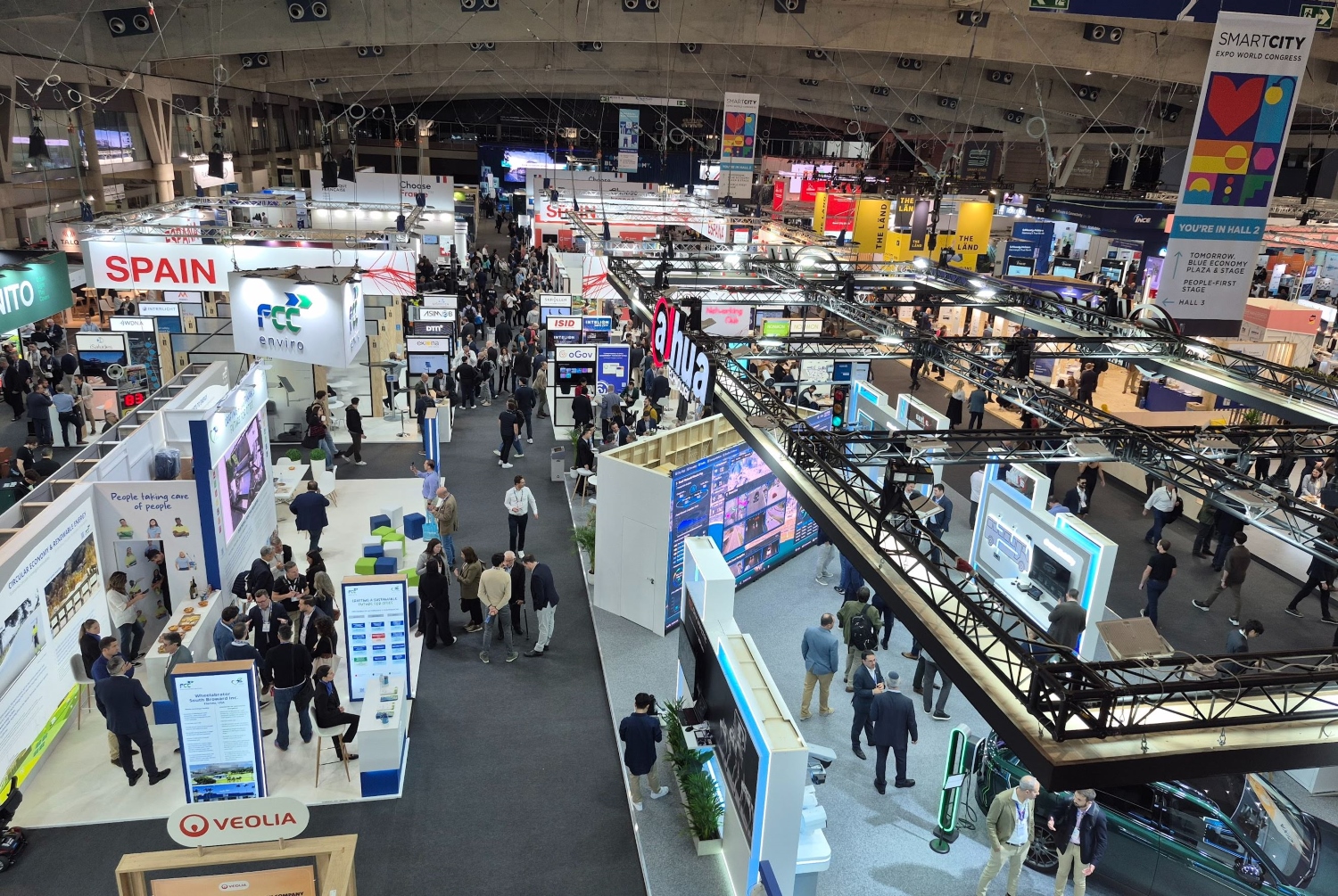
EICMA in Milan (Nov 5-10). Smart City Expo World Congress in Barcelona (Nov 4-6). The cycling industry chose EICMA. We all but abandoned Smart Cities.
The result?
500+ stands. 1,400+ companies at Smart Cities. Cycling: a ridiculous ~4 entities and a paltry ~3 out of 250 sessions (correct me if I’m wrong?). That’s the unfathomable showing that cycling mustered at a premiere event for urban solutions, policymakers, and city governance.
Smart Cities is here to rewrite and build momentum for future urban life, yet Cycling wasn’t in the room. AI parking apps got more stage time than THE solution that needs no parking.
I like to share ideas and broader perspectives on LinkedIn. I’d hate to think I’m taking the position of a clickworthy “I’m a LinkedIn expert who knows what you all did wrong, I’m smarter than all of cycling’s industry boards of directors combined, and I’m the hero to save the day” type here. But today we need a bit of a shakeup. This guy here (me, the author) was awfully alone as a cycling industry individual walking around a phenomenal show. Our collective absence at Smart Cities here was unfathomable. So I’ll be bold.
The Room We Weren’t In
Japan, Korea, China, UAE, Saudi Arabia, Argentina, countless EU pavilions, the list goes on and on. The world was in Barcelona, all showcasing urban solutions.
Municipality stands looking for solutions.
Microsoft, Google, Nvidia, Bosch, PWC, Deloitte, KPMG: All present.
Technology ranged from the mundane (water runoff AI, street lighting), to inspired (AI systems to track near misses and collisions to aid public space planners improve designs), to satellites, all the way into the eccentric: a Thunderbirds-worthy telescopically ascending helicopter pad for a small town’s main squares. Something our hero puppets could integrate seamlessly into any storyline.
The SCEWC officially reports that a significant portion of its attendees are decision-makers (often cited as over 50%). Speaker and attendee lists consistently include:
⦁ Mayors (e.g., from Barcelona, Salt Lake City, and other global cities).
⦁ Government Officials (e.g., Transport Commissioners, Ministers of Public Space, State Secretaries for Transport, and Joint Secretaries from Ministries of Urban Affairs).
⦁ City Planners and Urban Development Leaders (e.g., those heading initiatives in governance, urban planning, and municipal services).
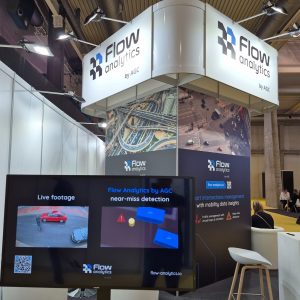
Impressive AI near-miss and collision analysis software to help urban space planners
There was (almost) NO bicycle thought leadership. Wait, what???
Fact: The Dutch Cycling Embassy has been here in years past – I believe inside the Netherlands pavilion. There were bike products at the very nice EIT stand. The European Commission’s Smart City Marketplace had its space. But the industry offered no physical platform, leaving the brave, lone players exposed and alone. Some melted into the background noise as a result.
This wasn’t a consumer show. We struggle to process that as an industry. This was where mayors, transport ministers, city planners, and infrastructure budget holders gathered to solve urban problems. These are the people allocating billions in mobility investments. These are the decision-makers who determine whether a city builds another parking garage or a protected bike lane network. Their decisions take years, but they are the people who make or break mobility policy.
As a larger economic ecosystem, cycling wasn’t there to make its case. Stated clearly:
Until the cycling industry provides our multiple unified organisations with a literal trade show stand island to occupy, they lose any beachheads they can take. They’re like rowboats in the ocean.
Credit due to industry players that were there: Lyft and Giant with bike sharing. One street bike garage company was there. One trendy-retro consumer bike manufacturer startup with a single product in its range was at a startup desk. Perhaps a few more I missed, busied inside, nestled stands.
Still, our greater absence stated: “Cycling = Sharing alone. Provision for personally owned bikes is not a smart solution relevant to policymakers”
That is an awfully painful example of strategic myopia. This is a systemic failure to lobby as an
industry – or perhaps worse… to adequately fund those who already DO lobby eloquently for us.
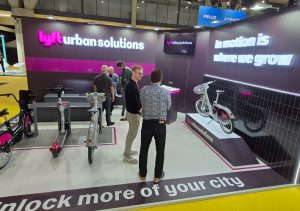
Bike share was the only flavour really present
When We Keep Riding A Tired Horse
Meanwhile, the bike industry was at EICMA in Italy. A big, beautiful co-opted motorbike show for the same tired recreational audience, doing the same thing… and magically expecting different results?
EICMA is the cycling industry’s comfort zone. We know the script: showcase the latest carbon layup, the newest electronic shifting iteration, the marginal aerodynamic gains. We’re speaking to “cyclists”, the dedicated enthusiasts who already own multiple bikes and will upgrade regardless of market conditions.
But here’s the brutal truth: that horse can’t carry us anymore. The recreational market is saturated, oversupplied, and shrinking. Beating this tired horse harder won’t make it run faster. We need NEW horses entirely. We need people to realise they can use bikes for practical reasons.
The stables for these new horses are standing in rooms like the Smart City Expo World Congress. They’re city officials desperate for congestion solutions. They’re transportation planners with mandates to reduce emissions. They’re public health directors trying to combat sedentary lifestyles and air pollution. They’re infrastructure investors looking for the highest ROI per dollar spent on mobility.
These are audiences that don’t care about your new gravel bike’s tyre clearance. They care about throughput per square meter of road. They care about cost per passenger-kilometre. They care about public health outcomes and carbon reduction targets.
And we’re not even showing up to these conversations.
We end up Flogging A Dead One
Have we forgotten that Corona brought years of demand forward, then a liquidation wave critically saturated the market with 30-50% discounts? With a product lifecycle of 5-7 years for dedicated riders and 10-20 years for casual users, anyone thinking we’ll recover by focusing on an attained market is delusional. People who want a bike now have one. Sure, I want a 32″ when they come out -Cool! But that will just suppress the new 29″ market further as the next 26-29 second-hand consumer sell-off wave starts.
These consumers are satisfied. Maybe until well into the 2030s.
I’m not expanding more on this. We all know it.
A Cost Barrier Isn’t the Issue
Let’s address the elephant in the room: yes, Smart City Expo World Congress costs more than EICMA. Floor space runs approximately 51-64% higher (€295/m² vs. €180-195/m²).
This wasn’t an impossible threshold. It wasn’t a staff issue: more than enough of us are free to man another show, together. This wasn’t a cost barrier that locked us out. This was a prioritisation decision.
And here’s the critical point:
A single bike company shouldn’t be going to Smart Cities alone. We need to collaborate and come as a unified solution and product stand.
When we pool resources—bike manufacturers, component suppliers, infrastructure specialists, advocacy organisations—the per-company cost becomes entirely manageable.
Other industries figured this out. National pavilions figured this out. Why haven’t we?
The question isn’t “can we afford Smart Cities?” The question is “can we afford NOT to be there?”
Cycling is fundamentally a low-tech, simple, physical infrastructure solution. That may feel like a misfit in a “Smart” event: It does not generate high-margin software licenses or data subscriptions. But if the cycling industry reframes the bike not as just a consumer product, but as the foundation of the smartest, most efficient, and lowest-cost healthy cities, a pavilion would have had an impact.
The Obsolete Playbook
How is it that we’re not only drowning in our own obsolete playbook, but have doubled down?
While cities are desperate for mobility solutions that reduce congestion, improve public health and quality of life… we’re showcasing the next incremental innovation to our saturated endemic market.
The strategic failure is this: we’ve positioned cycling as a recreational product for enthusiasts instead of what it actually is—the most efficient, cost-effective, scalable urban mobility solution ever invented.
Where should we be? At events like Smart Cities—repeatedly. First shows create beachheads, not tidal waves. Major reach requires relentless commitment. Many from cycling who were present in Barcelona were lurking in the shadows, not commanding the stage. I saw one major European cycling advocate there—as a visitor, not driving the conversation from the podium.
The Proof of Our Disconnect
Want proof of how catastrophically disconnected we were? The only bike manufacturer I saw was approached by a genuinely interested woman asking about step-through designs and kids’ seats. His answer? “No, people don’t want step-through bikes. I know for sure most bike sales are high frames, even women buy them. And nobody wants to carry kids on a bike.”
Heard on a lone bike industry micro-stand: “No, people don’t want step-through bikes. I know for sure most bike sales are high frames, even women buy them. And nobody wants to carry kids on a bike”.
This. Is. Not. A. Joke.
This manufacturer was at the RIGHT event, in front of the RIGHT audience, and completely failed to understand what he was being asked. He gave an astoundingly WRONG answer. This lady represented the future: utility cycling, family transport, and daily errands. She represented the billions in urban mobility spending that cities are allocating. She represented the audience that will drive cycling’s next wave of growth. But only if we can get out of our own way!
And he told her the market doesn’t exist. She was impossibly polite. But her face betrayed a very deep disbelief at the conversation she was having. In our greater absence, we effectively allowed this to be our industry’s position at the show.
WE need to find and elevate them. We need our own space!

Can we book a pavilion, and take this stage more often?
What We Could Have Been
Here’s what cycling’s presence at Smart City Expo World Congress could have looked like:
A unified industry pavilion showcasing cycling infrastructure expertise. Not individual bike brands competing for recreational market share, but a coordinated presentation of cycling as THE foundational urban mobility solution.
Data-driven presentations on cost-benefit analysis: €X per passenger-kilometre for cycling vs. €Y for cars. Square meters of city space required per person transported. Public health cost savings per kilometre cycled. Carbon reduction per modal shift percentage point.
Infrastructure case studies from countries that proved bikes are viable: The Netherlands, to show what a few decades of work deliver. The Paris cycling network team to show how to make a sprint transition. Seville to show how to go from 1-7% within complex national politics. Japanese delegates to show how placing responsibility for car parking on owners leads to eminently livable spaces without bike lanes. Perhaps Bogotá’s Ciclovía…. All to prove this isn’t just a European phenomenon that we can dismiss with “we aren’t Amsterdam”
Technology integration showcases: There was so much AI. As everywhere, it’s the flavour of the day. So use that bandwagon…. let’s show how cycling infrastructure connects with smart city systems, real-time capacity monitoring, predictive maintenance, integration with multimodal transport networks.
Policy frameworks and implementation roadmaps for cities at different stages of cycling infrastructure development.
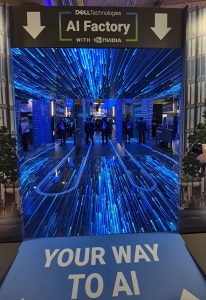
The cycling world chose the blue pill. “Your way to… irrelevance?!?!”
Instead, we had about four entities. Three sessions out of 250.
The technology companies, consulting firms, and other nations understood the assignment. They came to demonstrate solutions to urban problems. They positioned themselves as essential partners in building better cities.
Cycling should have owned its amazing value deliverables to this conversation. We are a phenomenal solution to urban congestion, air pollution, sedentary lifestyles, inequitable transport access, and climate emissions from transport. We’re the mobility mode with the highest benefit-to-cost ratio, the smallest spatial footprint, and the fastest scalability.
But you can’t win a conversation you’re not having. We need to take the red pill. We chose the blue one instead.
Leadership and Teamwork is the Way In
But here’s what IS within our power: We can fix this.
If you’re reading this from a brand, association, or advocacy group, join me in making sure cycling is in the room at Smart Cities 2026.
We need leadership focused on Total Addressable Market expansion, not individual companies fighting over their slice of the current pie.
EICMA represents the Serviceable Addressable Market—the recreational cyclists who already exist. Smart Cities represents the people defining the Total Addressable Market—the billions of urban trips that could shift to cycling if we positioned ourselves as THE infrastructure solution to policymakers.
Where do we start?
First, coordination. A unified cycling pavilion at Smart Cities 2026: private and shared bike manufacturers, component suppliers, infrastructure specialists, street hardware and design leaders, and advocacy organisations,… all presenting as one. Other industries figured this out. National pavilions figured this out. We must, too.
Second, let’s focus on healing. We need to recover from the self-inflicted wound of the liquidation crisis that saturated our market after the healthy corona uplift that added many new participants (Just ask any workshop if they have seen permanent post-corona uplift, and you have your proof). And no, we shouldn’t abandon core markets entirely. But industry health won’t come from incremental innovation for the same audience that we saturated. It comes from expanding the market entirely.
Third, mindset evolution. We seriously need to grow beyond the idea that our primary audience is recreational “cyclists.” I’ve seen this countless times on LinkedIn: Posts that get hundreds of shares. Even more times during (coincidentally, 100% bike) trade shows. And still… we aren’t getting it. People, we are like a takeaway pizza van trying to sell a pizza to people stumbling out of an all-you-can-eat diner… after a 6-hour marathon meal!
The recreational market isn’t dying—it’s stuffed. Our primary audience must be the decision-makers allocating urban mobility budgets—because they control access to billions of potential daily riders who haven’t been to the feast yet.
This requires industry leaders to stop thinking about quarterly bike sales to enthusiasts and start thinking about decade-long market transformation through policy influence. This requires us to stop competing with each other for the same shrinking recreational market and start competing with cars for urban space, infrastructure priority, and political will.
We can bring cost/benefit data per kilometre—bike versus car. We can showcase infrastructure expertise alongside mobility products. We can position cycling as it is: the smartest, lowest-cost mobility solution for cities.
Cycling missed the Smart City revolution — and that’s on us.
And this was just one event. There are so many other urbanism/transportation conferences where we’re just a lone voice being drowned out by the chorus of the car industry.
The question is: will we learn? Who’s ready to change this with me?
