
This is not your typical product launch Press Release-based feature. Because what’s being launched is far from your typical product.
Whilst Also. has, with the TM-B, developed and produced a vehicle with a two-wheeled form factor, it has as little in common with bicycles from the traditional cycling industry as a Software Defined Vehicle (SDV) has – produced by auto industry disrupting EV manufacturers – with an ICE-powered vehicle from the legacy auto industry.
In the auto industry, the SDV and EV have changed everything.
What impact will $300 million funded Rivian spin-off Also. have on new mobility? We’re here to find out.
During a 45-minute 1-to-1 call with Chris Yu, President of Also., we explored the thinking behind the product(s) and how that shapes what is being launched, as well as having a guided tour of features and functions, with ready-to-ride products set for those attending the launch event in San Francisco already in place.
A few of you will know that I have an interest in EV, on two-wheels and four, in certain aspects of technology and consumer electronics, as well as design (User Interface, or UI) and User Experience. The buzzword bingo catch-all phrase: “A seamless blending of software and hardware”.
I mention this because the language I’ll be using here comes from these worlds. I’m using these cues and reference points because they are the right ones for the job of describing what Chris and the team at Also. are bringing to the market.

Background and introductory overview
“Also was created to develop technology and products that challenge existing expectations for what is possible in form factors smaller than a car or truck – I couldn’t be more excited about the potential for Also. to help drive excitement for new modes of transportation. We have built a ground-up technology platform that enables us to deliver rich, personalised experiences that get better over time, through the power of software.” Rivian Founder and CEO RJ Scaringe.
 “Our vision is to bring together the latest technology with fun, thoughtful design to create small EVs that inspire people to adopt these more efficient modes. This launch has been years in the making, and it is just the beginning of a broader platform we are building that we believe will catalyse adoption globally.” Chris Yu, President of Also.
Let’s start with how TM-B looks.
Visually, there is so much to talk about and take in. I see clear motorcycle design cues, which have, to my eye, a ruggedness to them. The upside-down fork with a substantial-looking stanchion diameter. The rear swingarm and shock placement. The 24-inch wheel fitted with a 2.6″ tyre has a certain supermoto look to it (nobblies are available as part of the All-Terrain Configuration). Belt drive with a visible motor end small toothed sprocket, and a large rear wheel-mounted sprocket – both have a motorcycle-like look to them.
In contrast, the ‘frame’ has a very ‘friendly’ signature, an unintimidating outline or silhouette – with its ‘lowstep’ design – combined with soft-edged shapes and a finish – colour and texture – which have clearly been designed to encourage people to engage and interact with the bike. I revisit the ‘friendly’ word because it is an emotional response which designers work hard to create.
If this were a consumer electronics product, we’d be talking about how its ‘design language’ intentionally makes this visual statement – that it has been designed to encourage people to pick it up and explore it.
‘Tactile’ is the phrase.
Modular design for a variety of ‘everyday living’ needs and wants
Also. has designed the TM-B with 3 distinct capabilities engineered around the choice of ‘Top Frame’. This also means the bike can be ridden by anyone from 4ft 11 inches to 6ft 8 inches.
What is a Top Frame? Think ‘seat tube’ in conventional bicycles. Now imagine being able to remove the seat tube to reconfigure the bike. Oh, and each version comes with a neatly integrated rear light.

You can have a conventional Top Frame, a rear rack-equipped Top Frame, or a beach cruiser-style bench seat Top Frame. The Top Frame sits in a seamless recess and is held in place by an electrical signal, which can be engaged or disengaged from the Portal – a touchscreen control unit located where the top cap on a stem would be found on a traditional bicycle (more on this in a minute). The physical act of removing and refitting the top frame is easy and can be done using a single hand. No tools required.
What happens if I’m changing between Top Frames, and more than one person rides the TM-B?
Each rider’s seating position is remembered, based on their phone being paired to the TM-B. No faff, no tools, no stress.
Sounds simple when reading that back, yet who else currently offers this ‘simple’ solution…. And the power is in the simplicity. ‘Here is a problem. What is the simplest solution?’ It really is, ‘the more you think about it, the more striking it gets’ stuff.
Designing for solutions with high levels of real-world user benefit
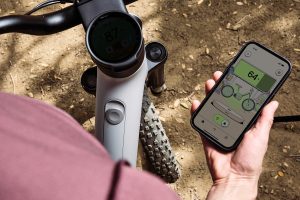
Interacting with the software, which shapes the user’s experience of TM-B, is done via ‘Portal’ – a 5-inch hi-res digital touchscreen display. Think of it as a combination of a cutting-edge smart sports watch and the non-voice call-based features on your mobile phone. Portal automatically activates when the rider approaches – ‘seamless and effortless’ is the statement being consistently made here.

I mentioned earlier that the bike pairs to your phone. This connection is similar to the keyless entry system on a car, where, on the modern four-wheeled SDV, it also sets user preferences, and enables people to connect with the wider Also. ecosystem.
Talking tech, and exploring the software, full navigation functionality is here, and I’m told this means live mapping on display with turn-by-turn capability – none of that Google maps Bike journey time here. Also. has developed the software specifically for riding, so your ETA is not the Google maps Bike ‘why does it say it will take so long?’ experience.
Connecting to other media and devices is also possible through the Portal and hand-control interface, with Also. putting thought into how a journey is taken and what drivers and riders do as they travel. Think ‘listening to podcasts whilst travelling’… More on this a little later.
Selecting ride type is also here.
‘Don’t want to change gears?’ is an actual question, and a real choice. Fully automatic mode is here for you as and when you want it.
Want to change gears? That’s just as easy to select via the touchscreen, and now you’re using a simple toggle switch on the handlebar (think Zirbel style shifter), putting the rider in full control. Manual mode also offers the rider fully customizable gear ratios. ‘How?’, I hear you ask. We’ll get into that in a minute.
Critically, the ultimate security feature on TM-B is the ability to fully ‘brick’ the bike. We’re not just talking about shutting down the Portal and hard-locking the rear wheel. We’re talking disabling everything.
Nothing works.
So breaking the bike into component parts offers no value to a thief. Nothing is usable – until the owner unlocks the system. Proximity to the owner’s phone, or use of the owner’s PIN code, are the only unlock options. And this is a major GPS-enabled benefit. Receiving alerts for unexpected movement. Being able to track the bike with confidence.
 Now, about that battery. Let’s call it a ‘power bank’.
A simple change of wording transforms how we see the product. It’s not semantics. It radically alters what we think we are getting. And if I have a power bank, I can charge other things with it. Take it with me and use it when not on the bike. Which means it is designed to look good (style being subjective) and packaged to be easy to carry. USB ports? Obviously.
Two spec options: 538Wh or 808Wh, offering 60 miles or 100 miles of range.
How does Also. update and integrate?
Just as your phone gets updates, so does an SDV. Naturally, Also. will deliver updates. As the business points out, its technology platform is built on the same state-of-the-art, vertically-integrated principles as the most modern EVs in the world today.
Take Over-The-Air (OTA) updates as an example. In the world of SDV, this is the norm’.
Like any software, there are versions. During the life of the product, enhancements of existing features are introduced. New features are added. If you can add new features, you can make future hardware adaptations. The product evolves. Early owners go on a journey with the product. They’re not left stranded with a superseded, outdated version.
In the cycling and outdoor space, we already see elements of this with the likes of Garmin and others launching new products (hardware) and offering software updates to existing owners of previous-generation devices. Mobile phone manufacturers arguably set these wheels in motion, with major software updates adding new features during the life of the handset.
Critically, when your device has a rich feature set – offering multiple useful features and functions – this integrates it much more distinctly into the user’s daily life. In product development speak, ‘making it sticky’ means building features which offer unique value, forming deep connections, creating a strong sense of value, and loyalty.
Here, an ecosystem is the ultimate example. Think Apple products, iOS and macOS, and the way users choose to embrace Apple as an ecosystem, not just pieces of hardware.
In-house innovation, free from constraints
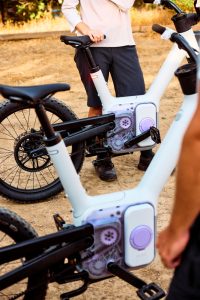 Also. has developed its DreamRide propulsion system in-house, giving it full control over every aspect.
In fact, the entire project is completed in-house.
In the auto industry, this is the much-discussed ‘vertical integration’. Minimal external suppliers (Just tyres and windscreen for some leading EV makers). No distractions. Just a unified clarity of focus on delivering the end goal. And then there’s the business efficiency (cost saving). We’ll come back to this when we talk price, a little later in this article.
What’s unique about DreamRide is that the motor and pedals are not connected.
You read that right. Pedal-by-wire is here.
A true SDV moment. We’re in the big leagues now. In the world of four-wheeled EVs, the equivalent would be steer-by-wire.
When you disconnect the pedals from the motor, you open up a world of possibilities.
- That fully customisable gear ratio option: Possible because software connects motor and pedals.
- F1-style energy regeneration (~ 25% of charge) going up hill and down hill: That’s possible because the software connects the motor and pedals
- Performance mode, with feedback through the pedals when changing gears. Yeah. For real.
- Software served ride characteristics which make the drivetrain responsive when riding over roots on a trail. No need for more or less pawls in the freehub. Hardware upgrade not required.
- Now back on the street and cruising along. Back to full auto mode, where TM-B can also sense hills and adjust input accordingly.
- 30% gradient. No worries. Hill flattening feature constantly monitors grade of the ride and delivers extra torque to the wheels on ascents.
How confident are Also. that the pedal sensation is one that those who call themselves cyclists will enjoy?
I’m told that when DreamRide was in development, a group of test riders were specifically not told about the motor not being connected to the pedals, that software is responsible for the pedal feel. Nobody guessed. Nobody questioned it. Even when terrain saw riders making full use of the available 120mm of suspension travel.
Speaking of suspension, the Base spec TM-B comes with a coil fork and air shock, whilst the Performance spec TM-B is equipped with an air fork and a matching air shock.

How much thought has gone into this? Enough to ensure that when riding in geared setting (rider manually changing gears with bar-mounted shifter), the rider feels the gear shift through the pedals in the same way you would on a conventional bicycle! Attention to detail is clear throughout the conversation with Chris. ‘Small things which make a massive difference’ is very much a recurring theme.
Talking DreamRide, we should mention 180nm, 5 X or 10 X assistance, depending on which spec of TM-B, and – again, because of software being the controller – market-specific speed limits.
Giving context for those figures, Chris points out that best-in-class acceleration has been tuned to match the flow of cars and make it easier to ride with traffic.
‘Going’ logically leads to ‘stopping’, and here the TM-B offers hydraulic disc brakes with regenerative braking.
Vehicle classification is factory adjustable via internal software setting (manufacturer only), enabling Also. to deliver a USA, including California, compliant product. A UK and EU-compliant product. A speed pedelec at 28 mph, or, if desired, an EAPC at 15.5mph. Throttle up to 20 mph (where regulations allow) to allow riders to cruise without pedalling.
Being a true SDV also means no magnets on the cadence sensor, changes in wheel circumference, or pressing of buttons in a specific order to unlock another performance level. In short, no simple hacking to unlock additional, regulation non-compliant, speed.
Is this the future?
Will the launch of the TM-B come to be viewed as the beginning of the end of derailleurs and chains?
Possibly.
Consider that in the traditional cycling industry, ‘revolution’ currently looks like the idea of winning a World Cup Downhill round using belt drive, and maybe a gearbox. E-bikes have seen the introduction of the motor and gearbox combined, and the centred weight of an e-bike motor and battery has already seen WC DH riders adding weight to their analogue race bikes, after training on an e-bike and liking the ‘planted’ sensation the extra weight gave them.
Meanwhile, Also. has taken a giant leap, way beyond all of this. Just the pedal-by-wire would be enough for a traditional bike brand to be hailed as the developer of the next era-defining innovation. Yet with the TM-B, it’s one, connected element of an entire product revolution.
When mainstream media talks about EVs, most in the West will think of Tesla as the pioneers. When the mainstream legacy auto industry laughed, Tesla went their own way. It took a decade for legacy, mainstream, auto types to see the Tesla challenge as a very real and very serious threat to their business model.
The team at Also. won’t much enjoy the Tesla reference (being a Rivian-related business), but it does demonstrate the massive technological leap they have made, in a way that mainstream auto and cycling readers will hopefully see.
Is the TM-B an evolutionary step change?
Definitely.
If you’re the maker of a conventional e-bike, a traditional bike brand, Also. TM-B will pose some really uncomfortable questions.
– The Base model TM-B will go on sale for “well under $4000 USD MSRP” (price TBC at time of writing)
– The Performance model TM-B will cost $4500 MSRP
I don’t see much controversy in says that Also. will be a major market disruptor.
And I haven’t even mentioned the four-wheeled TM-Q quadracycle – which will come in a last-mile delivery optimised commercial form, and a general use option which has something of the stripped down EV beach buggy or Baja go-cart vibe to it. To read more about the TM-Q, hop over to our sister title, MicromobilityBiz.

How do you listen to your podcast and be seen by other road users, with Also.?
Earlier, I mentioned the ecosystem word, and mentioned listening to your favourite podcast whilst travelling. Also. has thought about the journey, thought about what we do when travelling in a car, and got a solution for you.
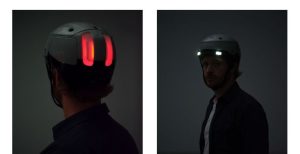
The Alpha Wave helmet delivers full connectivity, with four speakers – two per side – wind shielded, as well as two noise-cancelling microphones underneath the brow of the helmet. Chris highlights that the technology has been tested – you can take a call at 28mph without the other person knowing you’re riding – ensuring riders can fully utilise the capability of the speakers and microphones.
Being able to take a call, safely, at speed, aims to directly address and overcome one of the reasons why many people don’t currently get out of a car and onto a bike for the journeys where a bike is a better option. Not a problem for Also. Podcast on, calls taken, bike ridden.
Integrated into the Alpha Wave is both front and rear lighting. Rear lights show red light directed as a beam, whilst up front you have near and far lights offering up close ‘task’ lighting (think searching for a key in your bag), as well as depth of field for on-the-move vision and visibility.
What’s that? You want me to talk safety, given this is, after all, a helmet for a 28 mph capable Speed Pedelec.
Well, the Alpha Wave incorporates the recently launched Release Layer System (RLS), which “reduces concussion risk by up to four times compared to conventional helmets and by 63% compared to the best existing helmet safety technology today”. The Apha Wave also utilises HighBar’s mono strap.
The Alpha Wave saw Also. working with Greg Shapleigh, a renowned helmet expert who has worked with Specialized, Giro, Bell Sports, and sat on the board of directors, having previously worked in an advisory role at MIPS. Today, Shapleigh is chairman of HighBar.
And the best part: All this tech is packaged in a way that delivers a good-looking helmet (accepted looks are personal preference – ‘subjective’ – and I’m no style guru….)
Who buys from Also.?
Irrespective of two-wheels or four, the question is ‘will the general public buy the product?’

My impression is that those early adopters of new technology will like what they see, and like even more what they feel when getting hands on with Also. products.
The visual signature is right for this audience. The design language will feel both familiar and innovative, at the same time. Familiar in appearance, yet delivered in an entirely new form factor. An Apple product on two wheels. A NuPhy keyboard with those coloured keys and contrasting greys and off-whites, matched by a deeply satisfying touch and sound – no matter how slow or fast your keyboard skills.
None of this happens by accident.
Sensory experiences and impressions are deeply researched and extensively tested.
Will cyclists buy from Also.? Why not? If that N+1 garage has a transport and leisure-focused ride in it, and you’ve not yet made the e-bike move, why would you not consider the package that Also. is offering. Where else are you getting this kind of versatility, ride experience, technology, innovation and price point?
Adding to this, a range of accessories, including a fork-mounted rack, panniers, a Passenger Kit, mobile phone mount and stem accessory mount – options to make the TM-B a complete daily transport, weekly food shop, commute to and from work, solution, as well as a great weekend cruiser.
Preorders and reservations for ALSO’s TM-B are available at RideAlso.com, with deliveries beginning in spring 2026.
Conclusion
Also. has radically changed what two wheels can offer. A conventional e-bike looks rather simple, basic, stingy even, in comparison.
The bar has been massively raised.
Now we wait to see how legacy bike brands and businesses respond.